Interview Scorecards for RevOps Positions
A structured scorecard prevents mis-hires that derail forecasting and cross-functional alignment.

Revenue operations moved from back-office afterthought to board-level function faster than most hiring processes could keep up with. Gartner projects that 75% of high-growth companies will run on a RevOps model by 2026, and Skaled's RevOps Trends report found that 79% of organizations already had a formal function in place heading into this year. The infrastructure for finding and evaluating that talent hasn't caught up, and that gap is where most RevOps hires go wrong before an interview is even scheduled.
Skaled found that nearly 40% of formal RevOps teams were stood up within the past two years. That single number explains a lot: most hiring managers building scorecards for this function have never actually hired for it before. They're improvising, borrowing rubrics from sales or marketing ops, and calling it done. Skaled's own read on the broader trend is blunt: companies installing VPs of RevOps without the systems, maturity, or enablement underneath them produces a leadership title sitting on top of no infrastructure at all. A mis-hire here doesn't just cost a salary. It stalls the forecasting model, the tooling roadmap, and the cross-functional alignment the rest of the revenue org depends on to hit its own numbers.
This piece takes the position that most RevOps scorecards fail because they treat systems thinking, data fluency, and cross-functional influence as one undifferentiated blob of "ops skills." Those three things pull apart hard by seniority level, and a scorecard that doesn't separate them will keep selecting the wrong person, quarter after quarter, regardless of how many rounds the process runs.
What structured scorecards fix for RevOps
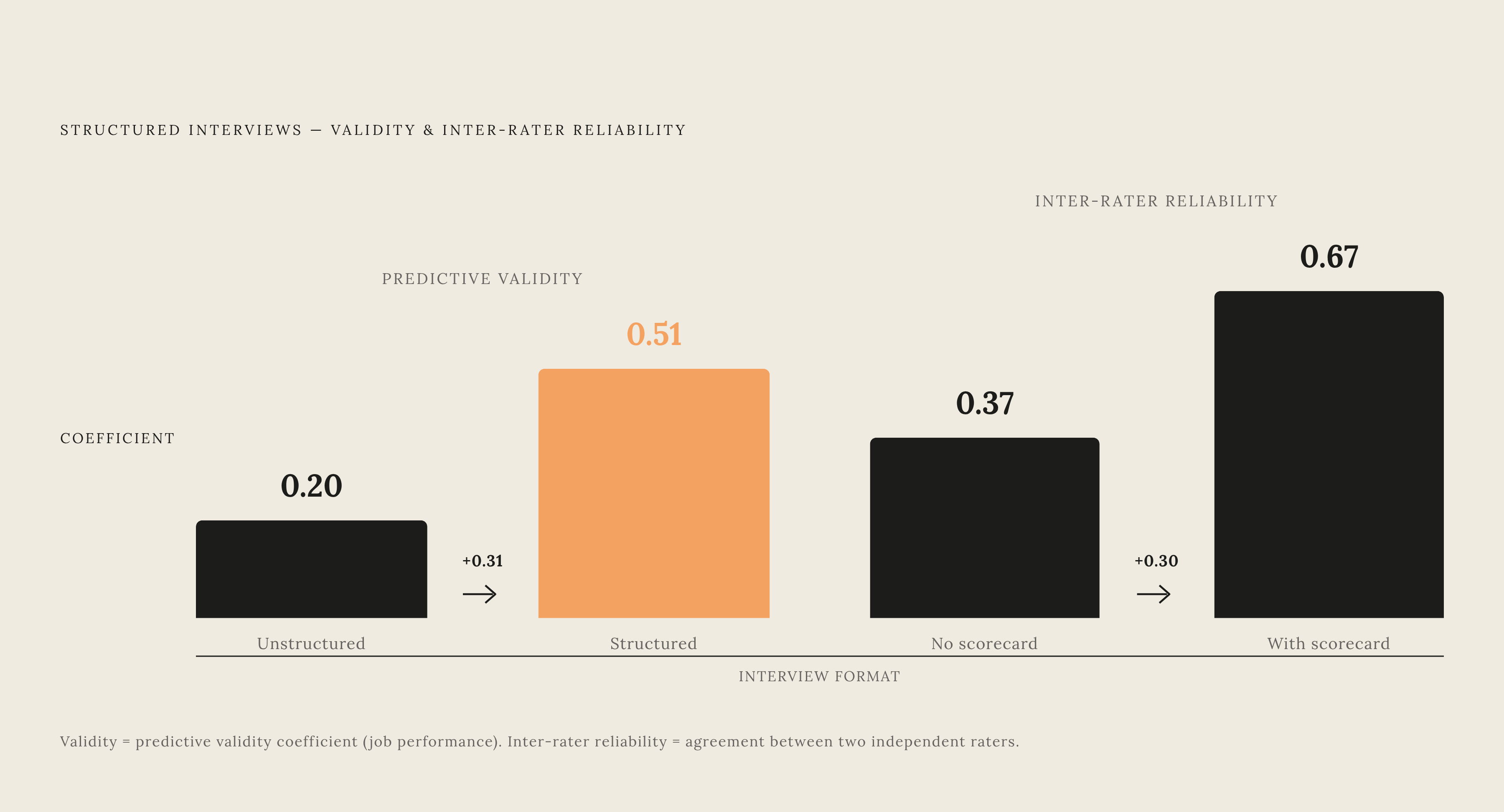
Start with the validity numbers, because they settle the argument before it starts. Unstructured interviews, the kind where someone just talks to a candidate and forms an impression, predict actual job performance at a validity coefficient of roughly 0.20. Structured interviews, scored against a defined rubric, reach 0.51, SHRM research cited by KlearSkill found. That's not a marginal gain. It's the difference between a coin flip with extra steps and a method that tells you something real about the person sitting across the table.
Panel dynamics make the unstructured version worse than useless. A 2022 study by Lim and Highhouse, published in the Journal of Applied Psychology, found that unstructured panel debriefs reproduce the opinion of the most senior or most vocal person in the room 71% of the time. Not the candidate's actual performance, the loudest opinion in the debrief, whether or not that person watched the interview closely or knows the competency under discussion at all.
Scorecards attack that problem directly. nextmantra.ai puts inter-rater reliability, the odds that two interviewers land on the same rating for the same answer, at around 0.37 without a scorecard and 0.67 with one. None of that is specific to RevOps. What makes the mechanism matter more here than in most functions is the number of hard-to-observe competencies stacked on top of each other in a single 45-minute conversation: whether someone thinks in systems, whether they can move a VP of Sales off a bad position without burning the relationship, whether their data instincts hold up under a real edge case. Gut feel is a weak instrument everywhere. It's a genuinely dangerous one when the signals are this diffuse and this easy to fake for forty-five minutes.
Hays reported that 72% of organizations now use structured interview processes, up from 66% in 2019. Real progress, and still not enough, because most of the RevOps scorecards circulating right now are technically "a scorecard" without being a good one.
The structural mistakes that make most RevOps scorecards useless before the first interview
The failure usually starts before anyone opens a spreadsheet. Teams build the scorecard first and define the problem later, which gets the sequence backward. A company saying it needs a "revenue operations leader" might actually need a systems builder, a forecasting partner, a process analyst, or a hands-on CRM admin, four different jobs requiring four different scorecards, as accountmakers.com frames it. The fix is to define what the hire needs to solve in the first 90 days and let competency weighting flow from that.
Competency overload is the second failure, and it's mechanical rather than conceptual. A 12-competency scorecard takes more than an hour to fill out properly, and interviewers under time pressure do one of two things: rush through it, or default to rating everything a middling 3, which defeats the purpose of scoring at all. nextmantra.ai's guidance caps any single scorecard at four to six competencies per round. candidate.fyi states that an effective scorecard needs four to six job-relevant competencies, a 4-point rating scale specifically (no midpoint to hide in), a required evidence field on every score, and a final overall recommendation.
Then there's the debrief, where even a well-built scorecard can get gutted by bad process. If interviewers discuss a candidate before scoring independently, the groupthink Lim and Highhouse documented walks right back in the door, and the reliability gains the scorecard exists to produce collapse on the spot. Independent scoring first, discussion second. That ordering isn't optional, and teams that treat it as optional are quietly throwing away the entire point of the exercise.
Two content mistakes round out the list, and both are common. Platform over-indexing, grading a candidate mainly on how deep their Salesforce knowledge runs, screens out people with superior process design instincts who happen to have spent their careers in HubSpot instead. The influence blind spot is quieter and more expensive: rework.com's hiring playbook notes that a candidate who scores below threshold on prioritization and stakeholder framing will produce excellent analysis that nobody downstream ever implements. A scorecard that doesn't grade influence explicitly will miss that failure every time, because the analysis itself looked sharp in the room.
The five competency dimensions every RevOps scorecard must cover
The five dimensions hold steady no matter what level you're hiring for. RevOps evaluation breaks into three broad bands, technical execution, business judgment, and influence, and those bands break into five assessable pieces. What shifts by seniority is the weighting and the depth of evidence required, covered in the next section.
Data and analytical rigor covers dashboard creation, CRM data hygiene, and the ability to explain a finding to a stakeholder who doesn't know what a join is. Fullcast's research notes SQL shows up as a strong differentiator among candidates but is usually listed as "preferred" rather than "required" in postings, and that analytical communication is frequently underweighted in how candidates present themselves. The interview probe should target governance, not tool fluency: if the underlying business problem is a lack of data trust, ask how the candidate defined shared metrics, monitored for drift, and corrected it once found, rather than which BI tool built the chart.
Systems and technical fluency appears concretely in the job market data. revopscareers.com's analysis of 1,890 Q1 2026 job postings found Salesforce named in 24% of them, the single most requested tool by a wide margin, with SQL and Excel each appearing in 11%. Grade platform breadth and adaptability here, not raw depth in one CRM: tool stacks change every few years, and the adaptable operator outlasts any single platform's relevance. For senior IC roles and up, this dimension shifts toward judgment. Can the candidate evaluate a build-versus-buy decision and sequence a tooling migration without breaking the workflows already running on top of the old system.
Cross-functional influence and stakeholder management sits at the intersection of sales, marketing, and customer success, and The ability to influence without formal authority is often the deciding factor between two otherwise comparable candidates. Soft-skills development is consistently underprioritized in RevOps team-building. The scorecard has to compensate for that gap rather than assume someone else already covered it. Run this probe: ask how the candidate handled a disagreement between a VP of Sales and a VP of Marketing over how "qualified pipeline" gets defined. That single question tends to separate the analysts from the operators faster than anything else on the sheet.
Revenue and business acumen has a clear fluency floor: hrcap.com lists sales cycle velocity, customer lifetime value, lead response time, retention, and churn as baseline literacy, since RevOps owns the unified view across functions rather than one department's slice of it. Technical skills get the candidate the interview, but business acumen gets them the offer. The right probe asks candidates to describe a process change they personally drove and quantify what moved downstream because of it, not what activity they completed.
Systems thinking and process design separates the strongest operators from everyone else with a Salesforce certification. The strongest RevOps professionals see interconnected systems where weaker ones see a pile of isolated tickets, and The right test is root-cause diagnosis over symptom patching. A candidate can know Salesforce cold and still think entirely in local fixes, patching one broken report at a time, never redesigning the process that keeps breaking it in the first place. Rolling out a new process also takes more than a clean project plan: it takes the ability to manage resistance and drive adoption under a deadline, and that deserves its own line of evidence rather than getting folded into "execution."
How to reweight the same five dimensions for analyst, manager, and director-level roles
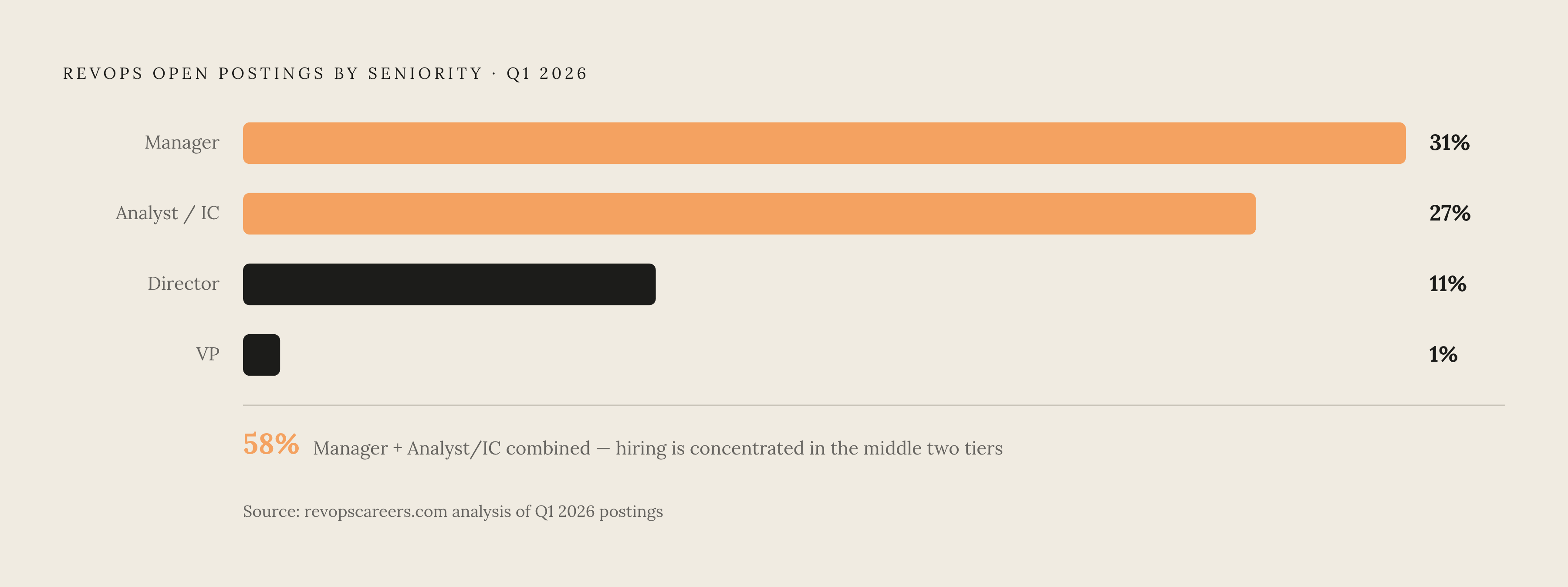
The five dimensions don't change. What changes is which ones carry the most weight, what counts as sufficient evidence, and what failure looks like at each rung. revopscareers.com found Manager and Analyst/Specialist roles together account for nearly 60% of all open RevOps postings in Q1 2026 (31% Manager, 27% Analyst/IC), with Director roles at 11% and VP at a thin 1%. Most organizations are hiring for the middle of the pyramid, and their scorecards should reflect that instead of the executive-search rigor that gets applied to a role posted once a year.
Analyst / Coordinator, roughly zero to three years, has one job: accuracy and reliability. They keep the machine running so everyone above them can make decisions on clean numbers. Weight data and analytical rigor highest, systems and technical fluency second, and let systems thinking and process design sit at the bottom of the stack, because redesigning the process isn't the job yet. The evidence bar: can this person catch a data discrepancy, explain the root cause in plain language, and document a fix, rather than redesign the underlying process from scratch. The typical experience threshold sits at zero to two years, with internships or adjacent ops experience often clearing the bar. Cross-functional influence gets assessed at its most basic level here: can they explain a finding clearly to a non-technical stakeholder, not navigate a standoff between two VPs.
Manager / Senior Analyst, roughly three to seven years, is where the scorecard has to catch a real shift: from executing a process to owning it. Elevate cross-functional influence and process design, keep data rigor high, but raise the bar from "can they run the report" to "can they govern the definition behind it." The single most diagnostic test at this level: can the candidate walk into a room with a VP of Sales and a VP of Marketing and get both to agree on what "qualified pipeline" actually means. Candidates who can't do that will stay analysts indefinitely, no matter how sharp their SQL is. Mid-level RevOps managers typically own territory and quota planning, forecasting workflows, commission plan administration, and cross-functional projects from scoping through implementation, so the evidence field should ask for one project they owned end to end: what broke, how they fixed it, what they'd change next time.
Senior Manager / Director is where business acumen and influence dominate, and technical fluency gets assessed as judgment rather than hands-on execution: build-versus-buy calls, vendor evaluation, sequencing decisions. Director-level roles are just 11% of postings but carry a median salary around $202,000, based on revopscareers.com's analysis of 485 US postings with disclosed salary data, so the scorecard has to justify that spend with real evidence of strategic impact, not a polished resume. The evidence bar shifts accordingly: can the candidate describe a forecasting or planning change that actually altered how leadership behaved, not a dashboard that looked good in a routine leadership review. Process design at this level turns into an org-design question: has the candidate thought through how RevOps should be structured relative to the company's stage, headcount, and go-to-market motion.
VP / Executive searches make up just 1% of the market, revopscareers.com reports, and they run thin and highly selective almost by definition. At this level, business acumen and influence essentially are the scorecard, and technical dimensions get assessed only as literacy: can the candidate evaluate what their own team produces and push back credibly on a vendor's claims. Skaled's 2025 analysis finds companies installing VP-level RevOps leaders whose systems and team maturity have not yet caught up to support the title, and this gap between title and readiness is exactly the failure mode this scorecard exists to prevent. Its job at this level is to surface whether the candidate has actually built a function from nothing, not simply inherited one that was already mature and running. The evidence bar: revenue growth or efficiency gains directly attributable to a structural change the candidate designed and championed at the executive level.
Putting the scorecard into practice: rating scales, evidence fields, and debrief protocol
Start with the scale itself. A 4-point rating scale, built deliberately without a midpoint, forces a directional call on every competency and kills the central-tendency problem where every interviewer rates every candidate a safe 3 out of 5 to avoid conflict in the debrief. That single design choice does more for scorecard quality than almost anything else on this list.
Every competency needs a required evidence field: a specific line the interviewer records, in the candidate's own words or actions, before a numeric score gets assigned. Skip this step and the scores turn impressionistic again, quietly erasing the reliability gains the whole structured process exists to produce. For cross-functional influence, a workable prompt: describe the specific disagreement the candidate named between two functions, who was in the room, what was actually at stake, and what they did about it. For systems thinking, a parallel prompt: what root cause did the candidate identify, and how far upstream from the original symptom did that diagnosis go?
Sequencing interviewers matters as much as the questions themselves. Assign each interviewer one or two dimensions to dig into, not all five, so no scorecard blows past the four-to-six competency cap, while the panel as a whole still covers all five dimensions by the end of the loop.
Debrief discipline is the rule most teams quietly skip, and it's the one that matters most. Every scorecard gets completed independently before anyone in the room starts talking. Skip that ordering, and the reliability gains the scorecard exists to produce collapse on the spot, because the loudest voice in the room starts shaping everyone else's memory of what actually happened in the interview.
Weighting has to be visible to the whole panel before the process starts, not discovered mid-debrief. A hiring manager who never told interviewers that business acumen outweighs Salesforce depth for this particular req will get panel feedback optimized for the wrong signal entirely, and by the debrief it's too late to recalibrate.
Finally, build in an overall recommendation field, separate from the individual dimension scores: hire, no hire, or strong hire. That separation matters because it lets a single critical failure, a below-threshold score on influence or prioritization, override an otherwise strong aggregate. The rework.com finding to carry into every debrief is that a candidate who can't prioritize or frame a stakeholder conversation will hand the business excellent analysis that nobody ever acts on. Catching that risk before the offer goes out is the entire job of the scorecard. Catching it ninety days later, during the post-mortem, is not.