Structured vs Unstructured Interviews in Tech Hiring
Structured interviews predict job performance twice as well as unstructured ones.
Structured and unstructured interviews measure whether a hiring process predicts anything reliable. Most interviewers treat the choice the way they'd treat a preference for open floor plans versus cubicles: some like free-flowing conversation, others like checklists, and both seem defensible.
Industrial-organizational psychology does not see it that way. It treats interview format as a psychometric problem: validity (does this predict job performance?) and reliability (would you get the same result twice?).
The mechanism behind why format destroys or preserves reliability is simple. The two formats differ across four concrete dimensions, question design, scoring, interviewer discretion, and what gets documented. Test Partnership's analysis on this point is precise: interviewers in that scenario "have no way to fairly compare results or know who truly performed better". Once a hiring panel has no fair basis for comparison, every downstream decision, who gets an offer, who gets rejected, who gets leveled into a senior role, rests on a foundation that cannot be defended on the data.
In tech hiring, where roles routinely combine deep technical judgment with ambiguous, cross-functional responsibility, the cost of an unreliable measurement compounds. A bad hire on an engineering team doesn't just cost a salary. It costs the productivity of everyone who has to review that engineer's code, cover for missed deadlines, or eventually redo the hiring process from scratch. Looked at purely as a measurement question, the research on which format holds up is not ambiguous. It has an answer, and the rest of this piece walks through what that answer actually looks like in practice.
How structured and unstructured interviews differ in practice
The two formats diverge across four concrete dimensions: how questions are designed, how answers get scored, how much discretion the interviewer retains, and what ends up documented.
A structured interview asks every candidate the same predetermined questions in the same order. Multiple interviewers score independently before comparing notes, and the final decision gets documented against criteria pulled from a formal job analysis, Pin's structured interview guide notes. Nothing about the format is improvised. The questions are fixed in advance, and so is the standard for judging the answers.
An unstructured interview works differently at every one of those points. Questions follow wherever the conversation goes, there's no predetermined scoring system, evaluation rests on the interviewer's overall impression, and there's no requirement to document the reasoning behind a decision, Test Partnership notes. That flexibility makes unstructured interviews feel more natural to conduct, and makes them harder to defend later.
Tech hiring complicates this picture because "structure" operates on two separate layers at once: the format of the interview itself, and the content being tested inside that format, whether that's behavioral and competency questions, whiteboard algorithmic puzzles, or work-sample simulations. A company can run a highly structured process that still tests the wrong thing, and a company can run a loose, conversational process that happens to probe relevant skills.
Amazon's hiring pipeline illustrates the structured end of the format spectrum. Behavioral questions tied directly to its sixteen Leadership Principles appear throughout the process, although the specific mix of stages and content shifts depending on whether the role is technical or non-technical. Google illustrates something more complicated: a standardized, multi-stage pipeline that is unambiguously structured in format, but whose algorithmic puzzle content Google's own internal research found correlated weakly with actual on-the-job performance. That distinction, format versus content, becomes central later in this piece.
A hybrid interview shows up often in practice as a compromise, though it hasn't been validated with the same body of evidence that backs the fully structured approach.
Validity research and where the numbers stand today
Across decades of meta-analytic research, structured interviews predict job performance substantially better than unstructured ones, and the most current evidence reaffirms that gap after a period of genuine methodological dispute.
The foundational finding, from 1994, found structured interviews nearly twice as predictive of job performance as unstructured ones, establishing the gap.
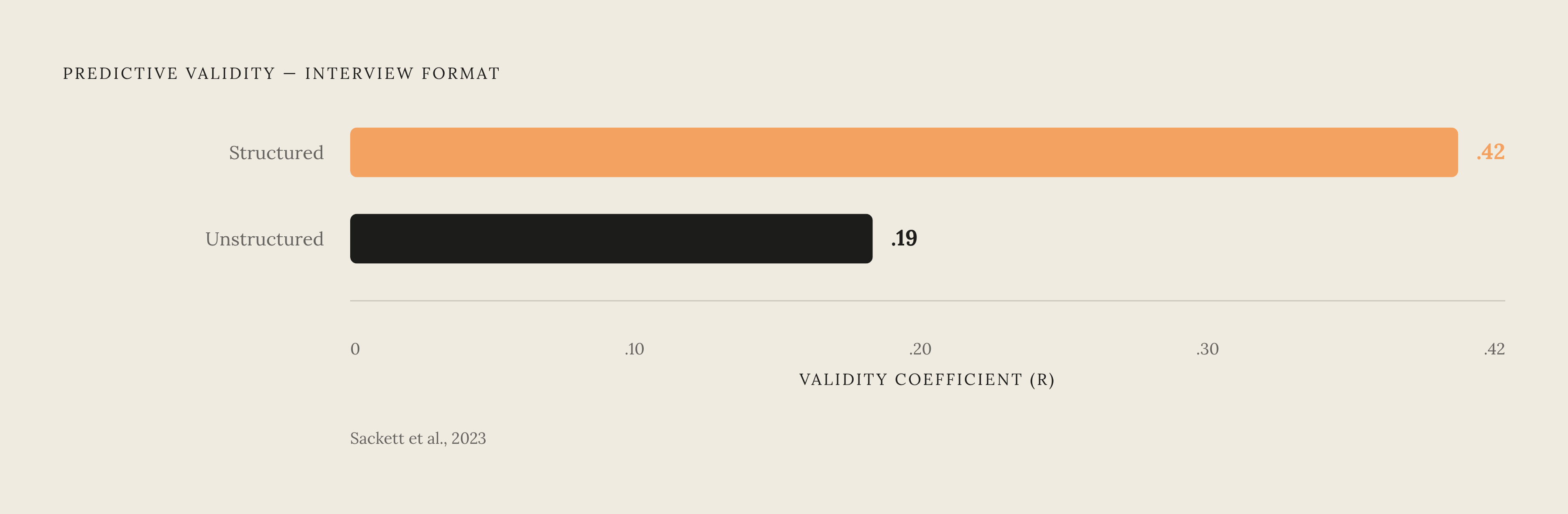
The most current large-scale analysis, from Sackett and colleagues in 2023, puts structured interview validity at.42, making it the highest-performing standalone predictor among commonly used selection methods, ahead of cognitive tests and personality measures evaluated on their own. Work samples, job knowledge tests, and biodata also rank among the top predictors in that same analysis. Unstructured interviews, measured in the same analysis, land at.19, making structured interviews roughly twice as effective at predicting who will actually perform well on the job, Test Partnership's review of the findings shows.
That gap has not gone unchallenged. A 2016 re-analysis by Schmidt, Oh, and Shaffer applied a statistical correction for range restriction that appeared to erase the difference entirely, bringing both formats up to.58. For a few years, that finding gave skeptics of structured interviewing a legitimate citation. Sackett and colleagues revisited those corrections in 2022 and found they had overcorrected for range restriction, restoring the gap; no single study should settle the question in either direction, but the weight of evidence favors structure. No single study should settle this question in either direction, but the accumulated weight of the evidence favors structure, and it has favored structure for a long time.
More recent work has pushed the finding past a single performance metric. A 2025 meta-analysis drawing on dozens of studies and tens of thousands of participants found structured interviews predict task performance at ρ=.30 and contextual performance, citizenship behaviors, team collaboration, and organizational commitment, at ρ=.28. Structured formats pick out who can technically do the job and who will contribute to a team beyond their formal duties, including cross-functional collaboration, code review quality, and mentoring junior engineers, all measurable dimensions of performance in tech.
Unstructured interviews let bias into decisions that look objective
The gap between formats affects whose performance gets measured fairly, and that raises the stakes for tech teams well beyond a simple efficiency argument.
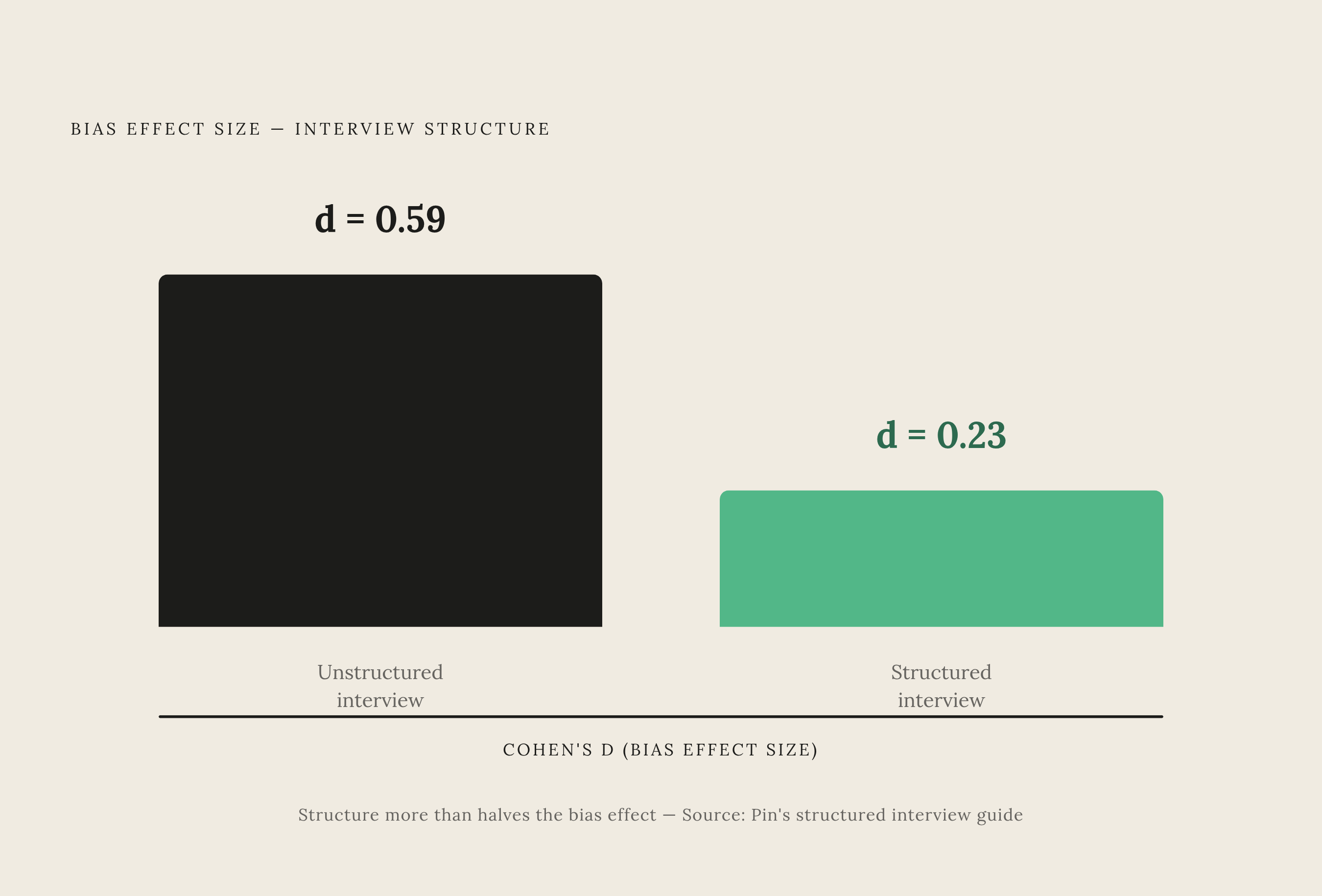
When a hiring process doesn't control what gets measured, what actually gets measured tends to be whatever is easiest for a busy interviewer to notice, and easiest often correlates with demographic proxies rather than job-relevant skill. The numbers bear this out directly. The bias effect size in unstructured interviews measures at d=.59, compared to d=.23 in structured interviews, Pin's structured interview guide reports, and structure more than halves the size of the bias effect.
Three mechanisms explain how this happens inside unstructured settings. Confirmation bias leads interviewers to focus on details that reinforce an impression they'd already formed before any substantive questioning began. Affinity bias pushes interviewers toward candidates who share incidental background markers, the same university, the same hometown, rather than traits that actually predict job success. And "culture fit," used loosely, becomes cover for excluding candidates whose backgrounds differ from the team's, dressing up demographic similarity as cultural alignment.
These mechanisms appear in documented outcomes in tech specifically. A majority of Black tech professionals report having faced racial discrimination at work, with hiring decisions shaped by entrenched bias rather than any real shortage of qualified candidates. Gender bias operates through the questions themselves, not only through scoring after the fact: a substantial share of women report encountering gender-biased or inappropriate questions during interviews, and a comparable share report feeling discriminated against because of gender, problems a standardized question set structurally prevents by design.
The bias doesn't disappear when the interviewer belongs to the group being discriminated against. A 2012 study published in the Proceedings of the National Academy of Sciences had science faculty evaluate identical application materials, varying only the applicant's name to signal gender. Both male and female professors rated the male applicant as more competent and offered him a meaningfully higher starting salary. Training or good intentions on the part of the interviewer do not fix what an unstructured process leaves open.
The practical consequence extends past fairness into legal exposure. Structured interviews generate a documented record tied to formal job analysis, which can withstand scrutiny if a hiring decision is ever challenged. Unstructured interviews generate decisions that are difficult to justify after the fact, because there's no rubric or documentation trail explaining why one candidate scored higher than another, Pin notes. Regulators have started paying attention to this exposure as it extends into automated hiring tools, a signal that the legal risk around unmeasured or poorly validated hiring criteria is only growing, not fading.
Why tech hiring has been slow to adopt structure
If the evidence is this consistent, the obvious question is why so many tech companies still run unstructured interviews. The reasons include real setup costs, a legitimate objection about content, and a genuine attachment to the feeling of gut judgment that data alone doesn't dislodge.
Setup cost is real and shouldn't be waved away. Building a structured interview script requires a formal job analysis, careful question design, development of scoring anchors, and calibration across every interviewer who'll use the rubric. All of that takes time and expertise that fast-moving teams rarely have to spare, Test Partnership notes.
There's also a perceived rigidity that interviewers report honestly: structured formats can feel mechanical, and interviewers worry they lose the ability to chase an unexpected strength that a fixed question set wouldn't surface. That concern isn't irrational on its face, even though the research suggests it often reflects overconfidence in gut judgment rather than a real cost of structure. Test Partnership notes that around 44% of organizations still use unstructured interviews despite the research consensus running the other way, a persistent adoption gap that has held for years.
The strongest version of the objection to structured interviews in tech is about content. Whiteboard algorithmic interviews are themselves highly structured: same problem, same rubric, same scoring criteria across candidates. They were often testing the wrong things, knowing a specific algorithm cold, tolerating stage fright while performing under scrutiny, and writing legibly on a whiteboard, of which at least two have nothing to do with how someone actually performs as an engineer. That is a legitimate critique, and it deserves to be treated as one rather than dismissed alongside weaker complaints about structure feeling too rigid.
"Structure feels bad" is rebuttable by the validity data already covered. "We are structuring evaluation around the wrong content" is a real problem tech hiring is now being forced to confront.
AI ubiquity and integrity pressure are restructuring what tech teams test
Two converging pressures, AI-assisted cheating and AI-augmented work itself, are breaking the validity of any structured format that tests isolated solo problem-solving, independent of how well-designed that format's rubric might be.
The integrity side of the problem has escalated fast. CodeSignal reported that cheating and fraud attempts on proctored assessments more than doubled between 2024 and 2025. A 2025 survey by interviewing.io, drawing mostly on interviewers at FAANG companies, found that most respondents suspected at least one candidate of using AI during an interview, and a large majority believed AI assistance lets weaker candidates pass interviews they'd otherwise fail.
The ecological side of the problem cuts the other way. CoderPad's State of Tech Hiring 2026 report found that a large majority of developers consider generative AI genuinely useful in their work, a share that's grown from the year before, and more than half say they'd see a measurable drop in their own productivity if AI tools were taken away. An interview that bans AI outright is measuring performance in a working environment that doesn't exist anymore for most engineers on the job.
Some companies are already rebuilding around that reality. DoorDash announced in April 2026 that it is restructuring its engineering interviews around AI-assisted working sessions. Its "Code Craft" round now has candidates build a small working service that mirrors real DoorDash logistics, something like a pay calculation system or an order assignment engine, instead of solving an abstract algorithmic puzzle. Google announced its own AI-assisted coding round for software engineering candidates, set to pilot in the US in the second half of 2026, confirming that even the company most associated with algorithmic interview structure is recalibrating what its process actually tests.
Handing structure over to an AI evaluation tool carries its own risk if what the tool measures was never validated in the first place. HireVue's speech analysis tools, and its now-discontinued facial analysis tools used before 2021, disproportionately disadvantaged non-native English speakers and neurodiverse candidates. In 2025, the ACLU filed a complaint on behalf of a Deaf Indigenous woman who alleged HireVue's platform discriminated against her when she applied for a promotion at Intuit. Automated isn't a synonym for unbiased, and it isn't a synonym for valid either.
What's getting scored more heavily across 2026 reflects where the real differentiation between engineers has moved. Communication, collaboration, and the ability to explain reasoning clearly now carry more weight, because in an environment where AI tools handle a growing share of raw code production, the distinction between engineers is no longer who types fastest. It's who thinks clearly, articulates their reasoning under ambiguity, and makes sound decisions when the problem isn't fully specified.
What skills-based hiring adds to the structured interview case
The growth of skills-based hiring redirects structure toward content that's actually relevant to the job, which is precisely what the validity research has recommended all along.
TestGorilla's State of Skills-Based Hiring report found that a large majority of employers now use some form of skills-based hiring, up from under three-quarters in 2023. That adoption curve tracks the same underlying logic that drives the case for structured interviews: measure the thing that actually predicts performance, score it consistently, and document why a candidate passed or failed.
Work-sample tests and realistic simulations, the content layer that skills-based hiring emphasizes most heavily, draw their validity from the same principle that makes a well-built structured interview work. Both approaches ask candidates to demonstrate job-relevant behavior under conditions that mirror the actual role, scored against a fixed standard rather than an interviewer's impression. Format and content converge on the same conclusion: hiring decisions hold up only when the thing being measured is the thing that matters, and when the measurement itself is consistent enough to trust.
Sources
- Structured Versus Unstructured Interviews—Which One Cuts Bias by 85%?
- Structured vs unstructured interviews: definitive answer on which is best
- Structured Interviews: How to Run Them and Why They Work (2026) - Pin
- Evaluating interview criterion‐related validity for distinct constructs: A meta‐analysis - Wingate - 2025 - International Journal of Selection and Assessment - Wiley Online Library
- (PDF) The Validity of Employment Interviews: A Comprehensive Review and Meta-Analysis