Structured Rubrics That Reduce Halo Effect in Interviews
Properly designed rubrics block first impressions from contaminating how you score each job skill.
A single confident answer in the first ninety seconds of an interview can quietly rewrite the score on five competencies nobody has even asked about yet. That's the halo effect, and most companies still hire as if it doesn't exist. The fix is a structured rubric that forces an evaluator to judge each skill on its own evidence, because nothing short of that structure actually stops one strong impression from grading the whole conversat... It's a structured rubric that forces an evaluator to judge each skill on its own evidence, because nothing short of that structure actually stops one strong impression from grading the whole conversation.
The mechanism itself is old news. Edward Thorndike documented it in 1920 watching military officers rate soldiers: a man who scored high on one trait got rated high across the board, and a man who scored low on one got marked down everywhere, regardless of what he'd actually done. Willis and Todorov's 2006 Princeton study found people forming judgments of trustworthiness and competence from a face shown for 100 milliseconds, and giving them more time didn't improve accuracy. It just made them more confident in whatever they'd already decided.
Confirmation bias does the cleanup work after that first impression lands. The rest of the conversation turns into a hunt for evidence that supports the initial read, while anything that contradicts it gets waved off as an exception. The horn effect runs the same machine in reverse: a nervous opening drags every later judgment down even after the candidate settles in and answers everything else well. Both versions get fixed by the same structural interventions, because both depend on the same failure. Nothing stops one trait from bleeding into judgments about traits that have nothing to do with it.
Unstructured interviews make this worse because there's no fixed reference point to interrupt the drift. Every candidate gets a different set of questions, shaped by whatever the interviewer happened to notice first, so the first impression steers the whole conversation instead of getting checked against anything. The trait doing the steering is usually irrelevant to the job. An interviewer ends up rewarding charm or punishing nerves, and neither one predicts whether someone can run a discovery call or close a deal.
What halo-driven mis-hires cost, in GTM roles specifically
Bias in hiring is getting worse, not better. Greenhouse's 2025 data found 42% of job seekers reported experiencing bias that year, up from 31% in 2024. That's a jump in the wrong direction inside a single hiring cycle, and it argues against the idea that companies are quietly fixing this on their own.
The dollar cost backs up the concern. The Department of Labor puts the cost of a bad hire at a minimum of 30% of that person's first-year earnings. SHRM's range runs wider, 50% to 200% of annual salary, with executive-level mis-hires landing near the top of that band.
In sales organizations, the numbers get concrete fast. The Bridge Group's SDR Metrics Report puts average SDR tenure at 14 months before promotion or churn, and pegs the cost of an SDR mis-hire at $42,000 once recruiting, onboarding, and lost pipeline get added up. That's a quota gap, a territory sitting cold for a quarter, and a manager re-running the whole hiring loop with less runway than before.
WeWork is the same story at a much larger scale. Adam Neumann secured $4.4 billion from SoftBank after a 12-minute meeting, on the strength of charisma alone. Scrutiny stayed away because of the halo, and while it did, the business kept deteriorating. The eventual reckoning included a failed IPO and something close to a $39 billion collapse in valuation. It's an extreme case, but it runs on the exact same first-impression-to-confirmation-bias pipeline that plays out in a forty-five-minute interview loop. Just with more zeroes attached.
Only about two-thirds of organizations currently use structured evaluation, and Talent Board's CandE data shows candidates who went through a structured process report 21% higher fairness ratings and 36% higher assessment fairness ratings than tho... The ones that do see it pay off: Talent Board's CandE data shows candidates who went through a structured process report 21% higher fairness ratings and 36% higher assessment fairness ratings than those who didn't.
Why awareness training alone fails to break the halo
Bias training changes how people describe their own judgment. It rarely changes the judgment itself, and treating it as the fix is where most workplace equity hiring initiatives quietly waste their budget. A 2025 University of Washington study found bias dropped only 13% when participants completed structured self-reflection before interviews on its own. The real gains appeared only once that awareness got paired with an actual change in process.
Knowing about confirmation bias doesn't stop an interviewer from anchoring on one line in a resume and steering every follow-up question toward proving that anchor right. Knowing about affinity bias doesn't stop a conversation from drifting toward shared interests and away from the job's actual requirements, if there's no interview guide holding the agenda in place. Knowledge sits in one part of the brain. Habit sits somewhere else, and habit wins in the room.
The debrief is where this fails most visibly. Research on group decision-making consistently finds that unstructured panel debriefs tend to reproduce the opinion of the most senior or most vocal person in the room. That's the debrief functioning as an echo chamber, and bias-awareness training doesn't touch that moment. The training happens weeks earlier, and the debrief happens in real time, under social pressure, with a VP or a founder in the room.
Structure beats willpower because it changes what's easiest to do, not what people believe about themselves. Scoring a specific competency against a specific behavior has to be faster and easier than going with a gut feeling, or people will take the gut-feel path most of the time. That's process design, not a pep talk, and it's the argument the rest of this piece builds on.
What the research says structured interviews deliver
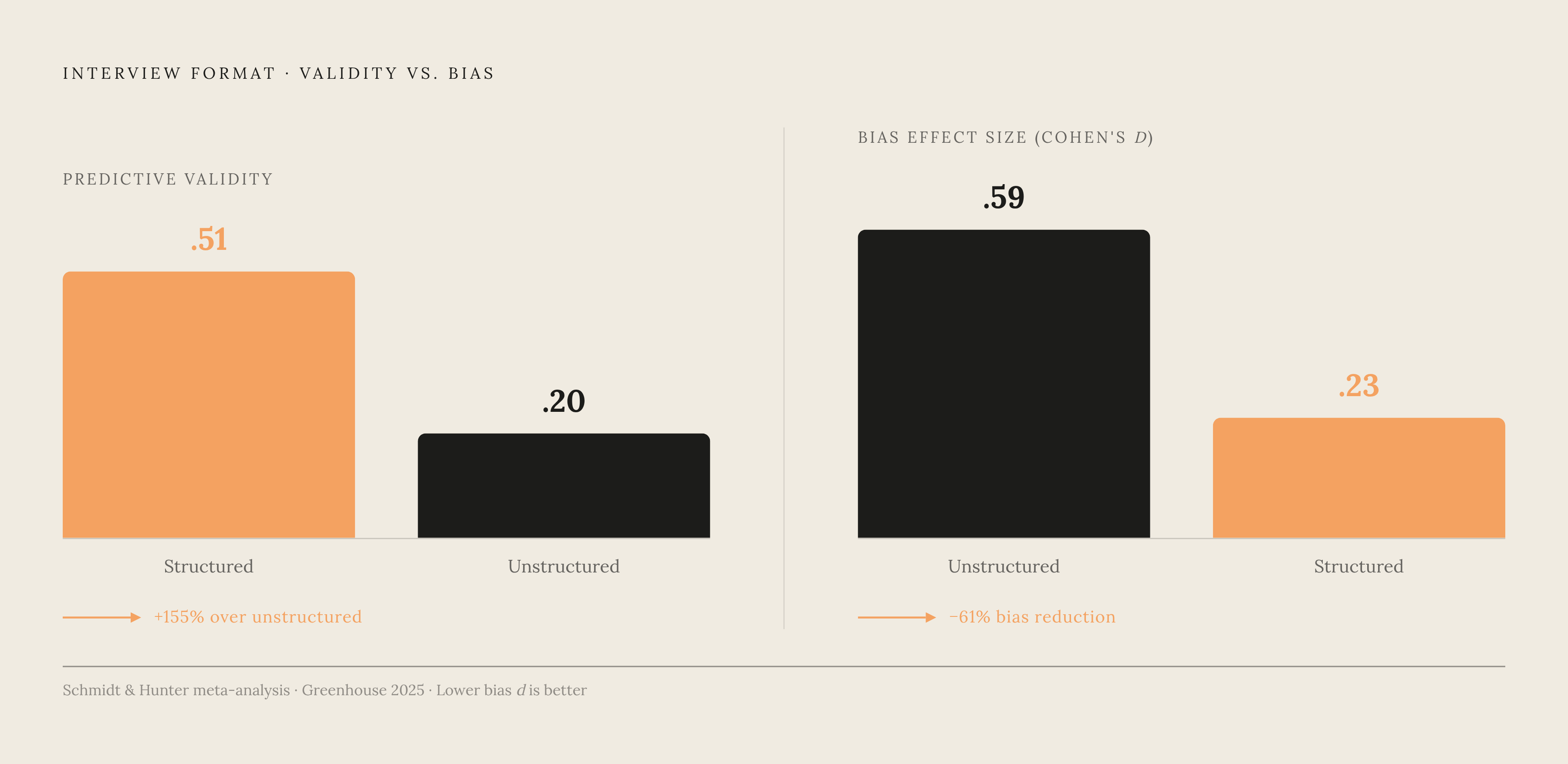
The predictive numbers aren't close. Schmidt and Hunter's meta-analysis, still the most cited work in personnel selection research, puts structured interview validity at.51 against.20 for unstructured interviews, a 34% jump in how well the format identifies who can actually do the job. A 2023 analysis by Sackett and colleagues lands structured interviews at a more conservative.42, and even there, it still ranks as the top standalone predictor among all commonly used hiring methods.
Bias shrinks by a comparable margin. Greenhouse's 2025 data shows standardized questions and rubrics cutting bias effect sizes from d=.59 down to d=.23, a reduction north of 61%.
The gains extend past raw task performance. A meta-analysis by Wingate and colleagues, drawing on 37 studies, found structured interviews predict contextual performance (collaboration, citizenship behavior, organizational commitment) at ρ=.28, and task performance at ρ=.30. Highly structured panels in that same analysis hit.78 interrater reliability and.57 predictive validity, both well above what unstructured formats typically produce.
Skills-based hiring has become the industry's stated direction, but the rubric is what makes it real. Without behavioral anchors tied to a job analysis, "skills-based" is a phrase on a careers page and nothing else. A rubric is the mechanism that turns intent into something that actually happens in the room: it reduces bias, and it produces decisions that hold up better across panelists, defend themselves better if challenged later, and predict job performance with more precision than a gut call ever could.
The four components that make a rubric work
A rubric that produces consistent decisions has four parts, and they depend on each other: competency definitions tied to the role, behavioral evidence indicators, anchored scoring bands, and calibration discipline across the panel. Pulling one out causes the other three to lose most of their value.
Competency definitions come first, and they need to trace back to a job analysis. Four to six competencies per role is the workable range: enough to cover the real profile of the job, few enough that a panelist can score in real time without falling behind the conversation. Splitting these across panel members helps too. One interviewer owns technical depth, another owns behavioral competencies, a third owns collaboration and communication, which keeps the panel from stacking five redundant opinions on the same trait while missing the rest.
Behavioral evidence indicators do the actual work. Without them, a 1-to-5 scale just gives inconsistent judgment a number to hide behind. It looks standardized without being standardized, and the consistency has to come from the anchors themselves, not the scale.
Anchored scoring bands spell out, in specific behavioral terms, what a 1 looks like, what a 3 looks like, and what a 5 looks like for each competency. For "communication," a workable anchor set might read like this: a 1 means the candidate's answers come out unclear or disorganized, and the interviewer has to keep re-asking just to get a straight answer. A 3 means the candidate gives clear, logical answers and listens actively. A 5 means the candidate handles complex ideas with real clarity, structures answers without prompting, and anticipates the follow-up before it's asked. Skip the number 2 and run a 1/3/4/5 scale instead. That gap forces real separation in scoring and keeps candidates from clustering in a mushy middle where nobody stands out.
Evidence notes close the loop. Every score should come with two or three sentences documenting a specific behavior the candidate showed. Notes facts, not feelings: cite the behavior, skip the adjective. Done right, a scorecard takes ten to fifteen minutes to fill out right after the interview, while the specifics are still fresh, instead of blurring into a vague overall impression by the time the debrief starts.
Name the rubric with a version number: "Account Executive Interview Rubric v1.0, [date]." It sounds bureaucratic, and it is, but it's what makes ongoing calibration possible as the role itself changes over time.
Secondary biases that survive a poorly designed rubric
A rubric without anchors still leaves room for central tendency bias, where interviewers avoid both ends of the scale whenever they're uncertain or want to dodge a hard call. Scores pile up in the middle, and real differences between candidates disappear into that pile. The 1/3/4/5 scale exists specifically to counter this by removing the safe, ambiguous middle option.
Contrast bias appears in back-to-back interviews. A candidate scored right after an exceptional one tends to get marked down relative to that comparison, not against what the role actually requires. Absolute behavioral anchors fix this because they give the evaluator a fixed reference point that doesn't move depending on who walked through the door an hour earlier.
Conformity bias is the one that survives even a well-designed rubric if the debrief protocol isn't locked down separately. The same group conformity dynamic applies even after individual scores get filled out correctly, if those scores get discussed out loud before anyone locks them in. The fix is structural: everyone submits scores independently before any conversation starts.
The halo effect doesn't always live in the interview itself. It sometimes travels through the debrief instead, arriving the moment a senior panelist summarizes a take and everyone else's independent judgment quietly falls in line behind it. Organizations that require full written scorecards before any verbal discussion opens end up with evaluations that stay independent, because there's no window left for post-hoc rationalization to sneak through.
Panel calibration and debrief protocol that preserve independent scores
Calibration has to happen before the first interview, not after the last one. A fifteen-minute session where the panel reviews the rubric together, talks through what each score level actually looks like, and practices scoring one hypothetical answer as a group gets everyone reading the same anchors the same way. New panelists benefit from pairing this with shadowing an experienced interviewer, so they're not learning the rubric cold in front of a real candidate.
The rule that matters most: no talking before writing. Every scorecard gets submitted independently before anyone opens their mouth in the debrief. That single rule blocks anchoring, halo bias, and after-the-fact rationalization all at once, because none of them can operate if there's nothing left to react to.
Once every score is in, the moderator reveals them all at the same time, either on a shared screen or read aloud one after another. That simultaneous reveal is what keeps the first voice in the room from setting the tone for everyone else.
Tracking scorecard submission rates is a useful health signal for whether calibration is actually working. If completion starts slipping, the process is breaking down before the debrief conversation even starts, and it's better to catch that early than to diagnose it after a string of bad hires. On the decision side, Jill Macri, a former talent acquisition leader at Airbnb, benchmarks an 80% decision rate: if fewer than four out of five debriefs end with a clear hire or no-hire call, the loop or the rubric behind it needs fixing.
Drift accumulates over time as panelists start interpreting anchors differently. A periodic calibration check matters: gather panelists, compare scores against the anchors, talk through any big discrepancies, and rescore where the gap is wide enough to matter. That's what keeps the rubric honest across a full hiring season instead of just one clean loop.
Structure often gets mistaken for a slower process, and that assumption is backward. Data from BrightHire and Greenhouse in 2024, across 24 customers and 25,000 candidates, found AI-powered scorecard integrations cut interviews per hire by 27% and improved pipeline efficiency by 35%. Structure produces speed alongside fairness, not one at the cost of the other.
Candidates notice the difference too. Talent Board's Candidate Experience report found transparency about interview format ranks among the top three drivers of a positive candidate experience score. An email that simply says the company uses a structured format to evaluate everyone fairly does real work in how a candidate remembers the process, win or lose.
Applying structured rubrics to GTM and sales role hiring
Sales and GTM roles are uniquely exposed to the halo effect, because the skills that trigger it are the exact skills the job selects for. A confident opener, a polished story, natural rapport: these are table stakes for someone applying to sell. The halo trigger is baked into the interview dynamic before a single competency question gets asked. Most sales hiring loops don't correct for this. They amplify it, because the interviewers are often reformed quota-carriers who respond to the same charisma cues the candidate is trained to produce.
An anchored rubric forces the distinction that matters. "Great energy" and "strong culture fit" are impressions, and they don't belong on a scorecard next to something like pipeline generation or objection handling, which can be scored against actual behavior by checking whether the candidate described a specific deal, a specific objection, a specific number they moved. A rubric built around behavioral anchors makes that gap visible instead of letting charisma quietly stand in for skill.
The star-performer-to-manager promotion is a distinct halo variant, and it's the one companies get wrong most often. Gallup research shows organizations pick the wrong candidate for sales management at a high rate, largely because they promote the best individual performer rather than the person with actual coaching ability and team-leverage instinct. Those are different skill sets, full stop, and a top closer is frequently the worst coach in the room. A rubric that scores coaching disposition and team leverage as separate competencies from individual quota attainment is the structural fix, the same logic that separates "communication" from "pipeline generation" at the interview level.
For RevOps teams, there's a systems argument too. A structured rubric generates consistent, comparable data across every panelist and every loop, and that data is auditable and trend-able in a way that gut-feel hiring never is. It feeds directly back into how a company refines its ideal candidate profile for the next round.
A repeatable, high-signal hiring process runs on the same principle as a repeatable, high-signal pipeline motion: defined criteria, consistent execution, and a process that beats intuition on both sides of the table. Teams that already build their pipeline on structured, criteria-driven outbound are, in effect, already running the same logic a well-built interview rubric brings to hiring. The tools differ. The discipline doesn't.