Predictive Validity of Pre-Employment Assessments in B2B Sales
Data shows which pre-employment tests actually predict sales performance, not just interview charm.
MarketSource reported that B2B sales turnover jumped from 22% to 36% in 2024, a 64% spike in a single year. That number matters because it's downstream of a hiring process most sales organizations still run on gut feel: a resume scan, two rounds of unstructured chat, and a decision made in the last ten minutes of the final interview. This piece lays out what the data actually says about pre-employment assessments in B2B sales: which types predict quota attainment, which ones are popular but weak, and how to sequence them into something a hiring team can run at volume without drowning candidates in busywork.
The stakes are these. The RevOps Coop found only 27% of sales reps hit quota in the first half of 2023, and a Gartner survey of 501 sellers found 77% struggle to complete their assigned tasks efficiently. Selling Power puts the share of companies reporting major skill gaps at 29%, with B2B sales cited as one of the sharpest pain points. None of that happens in isolation. A bad sales hire doesn't fail quietly: they burn a territory, sap morale on their pod, and eat months of ramp budget before anyone admits the fit was wrong from day one.
Resume screening, meanwhile, has lost whatever signal it used to carry. A growing share of job seekers now lean on AI to draft resumes and cover letters, and resume accuracy has become an increasingly documented concern, with inflated titles and overstated technical skills among the most commonly cited issues. What's missing across most sales orgs is a structured, evidence-grounded screen that predicts quota attainment instead of interview charm. It's a structured, evidence-grounded screen that predicts quota attainment instead of interview charm.
What predictive validity means and why most hiring teams ignore it
Predictive validity is a specific, measurable thing: the statistical relationship between a test score and a real job outcome, like quota attainment, retention, or a supervisor's performance rating six months in. It is not "does this test feel rigorous" or "did candidates seem to take it seriously." It's a number, and per Criteria Corp, that number exists on a spectrum across assessment types. Some tests barely beat a coin flip. Others come close to the ceiling of what's statistically achievable in personnel selection.
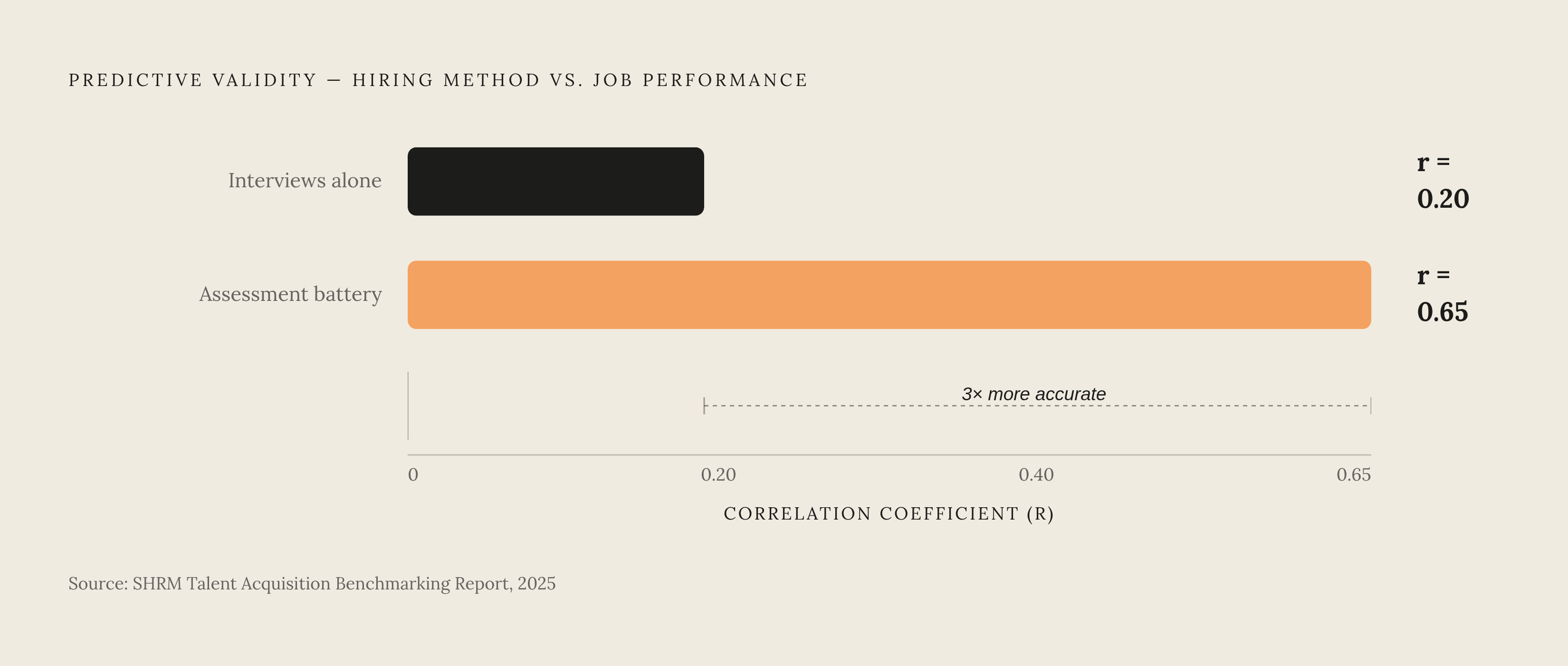
SHRM's 2025 Talent Acquisition Benchmarking Report puts the gap in stark terms: interviews alone predict on-the-job performance at a correlation of r=0.20. A properly built assessment battery lifts that to r=0.65. That's not a rounding error or a nice-to-have improvement, it is the single largest unforced error most hiring teams make, and they make it every single time they fill a seat on instinct. The same SHRM benchmarks show a combined battery predicts performance roughly three times more accurately than interviews alone, and it cuts time-to-hire by 30% to 50% in the process.
Popularity is not validity, a distinction sales leaders miss most often. No governing body stamps an assessment as "certified valid." Validity has to be demonstrated through published criterion studies tied to actual job outcomes, for actual job types, not vibes from a sales blog. So before signing with any vendor, ask one question and don't accept a shrug for an answer: what outcome was this assessment validated against, and for what role type? If the vendor can't point to a study, the tool is a guess wearing a lab coat.
With that standard set, the next question is which assessment types actually clear the bar for B2B sales roles specifically, because the answer is not the same across cognitive tests, work samples, situational judgment tests, and personality inventories.
Cognitive ability tests: high validity for complex roles, limited use in most sales contexts
Cognitive ability tests carry the highest stand-alone predictive validity of any pre-employment assessment for roles that demand complex problem-solving. The meta-analytic correlation, drawn from Schmidt and Hunter's research and summarized by SHRM, is r=0.51. That's a real number, earned across decades of study, and it deserves respect. These tests measure verbal, numerical, and abstract reasoning: how fast and how accurately a candidate processes dense, unfamiliar information under time pressure.
Where do they belong in sales hiring? Mostly in technical or enterprise seats, where the product learning curve is steep, the procurement cycle is genuinely complicated, and the rep needs to build a financial model or navigate a multi-stakeholder formal buying process. For field sales, high-volume SDR work, or account management roles that run on relationship craft, cognitive tests carry less weight, because a high score on abstract reasoning says nothing about close rate, objection recovery, or the ability to shake off five rejections in a row and dial a sixth number. Those behaviors, not raw processing speed, are what move the needle on quota.
There's a real trade-off to weigh here, too. Cognitive tests show measurable score differences across demographic groups on average, and that creates genuine adverse impact risk under EEOC scrutiny. The 2026 best practice is to treat cognitive scores as one input in a larger battery, never as a single-stage filter, and to set cutoff scores against actual criterion validity data rather than an arbitrary percentile that feels rigorous but isn't tied to anything. For SDR, BDR, or relationship-driven account roles, cognitive testing should not be the primary screen. Save it for technical and enterprise AE seats, where problem-solving must handle multi-variable pricing models, technical objections, and configuration logic under time pressure.
Work sample tests and situational judgment tests: the strongest predictors of sales-specific performance
If one assessment category deserves to anchor a sales hiring battery, it's work samples. CIPD's 2025 selection methods review puts the correlation between work sample tests and job performance at r=0.54, the highest of any method reviewed, and per the same CIPD data, work samples produce 40% to 60% lower adverse impact than cognitive tests alone. That combination, strong prediction plus a cleaner fairness profile, is rare enough that it should change how sales leaders prioritize their hiring spend.
For sales roles, a work sample looks like the job in miniature: a discovery call simulation, a cold email draft, an objection-handling scenario scored against a rubric. The design rule for 2026 is simple. Keep it under 60 minutes, and score it against a published rubric with four to six criteria, not a gut check from whoever's in the room. The historical objection to work samples was always cost and grading time, but Gartner-reviewed evaluation engines show AI scoring layers now hit inter-rater reliability of 0.78 against expert human raters. Work samples no longer have to be rationed to finalists only.
Situational judgment tests, or SJTs, are a complementary tool to work samples. Candidates respond to scripted, realistic scenarios: a client threatening to churn, a discount request above their authority, a competitor undercutting on price mid-negotiation. What SJTs score is decision quality under ambiguity, not knowledge recall, and that maps directly onto the judgment calls reps make daily. They are relatively quick to complete and suit roles where deals involve negotiation and multiple stakeholders. Structured behavioral screens of this kind are designed to predict on-the-job judgment more directly than resume screens alone.
Mock call or recorded roleplay assessments round out the picture, particularly for SDR and BDR seats where phone execution is the whole job. Tone, pace, and recovery after a hard "no" appear in a recorded call in ways no written test can capture. Taken together, work samples and SJTs offer the strongest combination of predictive power, sales relevance, and fairness of any assessment category available. They belong at the center of the battery, not tacked on as a final-round afterthought.
Personality tests underperform as quota predictors despite widespread use in sales hiring
DISC and Myers-Briggs have been fixtures in sales hiring for decades, and neither one is junk science. They're simply misapplied when used as a hiring gate. Criteria Corp finds both tools carry real value for team building and professional development once someone's already employed, but neither is validated for pre-hire selection, and neither holds up under EEOC scrutiny as a legally defensible screening tool.
The core problem is conceptual: personality typologies describe behavioral preferences, not outcomes. A personality-type label from a common assessment tells you nothing concrete about whether a specific rep will hit quota under a specific comp plan, selling a specific product, against a specific set of competitors. Personality data has a real home, just not at the top of the funnel. It's useful for culture and values alignment, flagging retention risk, and personalizing onboarding once someone's hired. A candidate can crush a cold-call simulation and still clash badly with a team that runs on collaborative deal reviews instead of lone-wolf hunting, and that's a distinct mis-hire risk that skills testing alone will never catch.
Certain behavioral constructs, when measured with actual criterion validation, can correlate with tenure and quota attainment, and that represents a narrow but real exception to the broader weakness of personality-based screening. The distinction is between trait measurement backed by validity data and typology labeling backed by nothing. Research into sales performance suggests that specific behavioral tendencies matter more than broad personality type labels, because those tendencies can be validated against real outcomes in ways that DISC quadrants cannot. The lesson for hiring teams is to screen for the underlying behavior, never the label.
Sequencing assessment types into a practical hiring battery for AE, SDR, and AM roles
Sequencing matters as much as selection. Early screens need to be fast and low-friction, and high-fidelity work samples should be saved for finalists. Strong sales candidates typically run competitive job searches, and a 60-minute assessment dropped at stage one will lose them to competitors who respect their time better. Keep early screens short, and reserve the longer exercises for the final two or three people in the running.
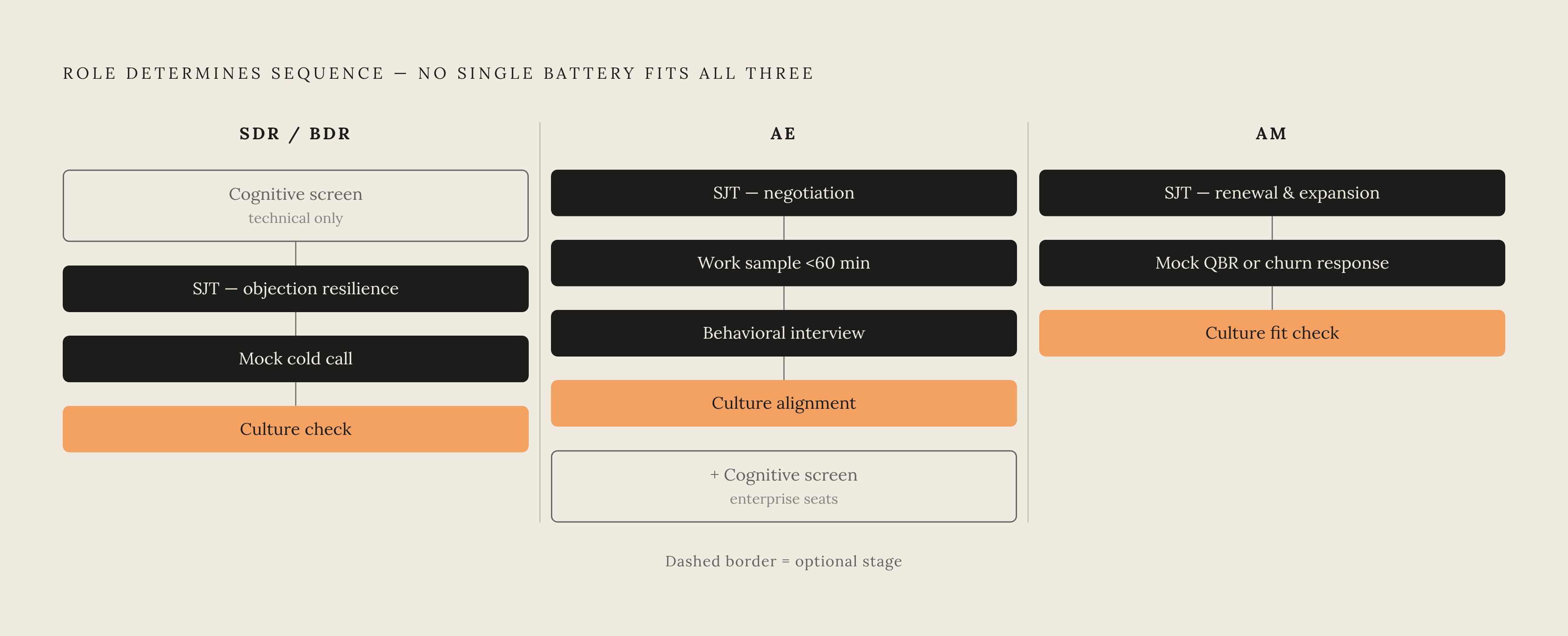
By role, the sequencing looks different. For SDR and BDR seats, start with an optional cognitive screen (only for technical products), follow with an SJT built around outbound volume and objection resilience, add a recorded mock cold call, and close with a values and culture check. Skip the cognitive test entirely for high-volume, relationship-led outbound roles, since the SJT and mock call already carry more predictive weight there. For AE roles, lead with an SJT covering negotiation and multi-stakeholder scenarios, follow with a work sample such as a discovery call simulation or a written deal strategy exercise (under 60 minutes, scored against a four-to-six criteria rubric), then a structured behavioral interview, then culture alignment. Enterprise or technical AE seats with a steep product learning curve can add a light cognitive screen on top. For account managers, prioritize an SJT built around renewal and expansion scenarios, a work sample like a mock QBR or a churn-risk response, and a culture fit check, since retention and relationship depth matter more here than new-business aggression.
None of this works if the battery lives outside the applicant tracking system. An assessment that requires someone to manually remember to send it becomes a step that quietly disappears after month two. Sales Assessment Testing reports that 78% of companies already report good results from skills-based hiring, so the shift is underway. The remaining question is whether a given battery is designed with intent or just adopted in a hurry. SHRM puts average cost-per-hire at $4,683, and a bad hire can cost many months of salary in lost productivity and cleanup. Against that downside, the cost of designing the battery properly is a rounding error.
Legal and compliance dimensions that sales leaders overlook when adopting assessments at scale
Any test used in a hiring decision that produces adverse impact against a protected group has to be shown, under EEOC standards, to be job-related and consistent with business necessity. That's not a suggestion, it's the legal floor, and assessments with no published bias or adverse-impact data are a live liability, especially for staffing firms placing candidates across multiple client accounts. Before signing with any vendor, ask a direct question: can you produce documented fairness testing across demographic groups? A vague answer means the risk sits with the employer, not the vendor.
Regulation is tightening the requirements further. The EU AI Act and New York's AEDT law are pushing a new buying criterion into 2026 conversations: audit trail and explainability. Klearskill's buyer's guide finds that tools that spit out a score with no visible reasoning behind it are losing ground to tools that can justify each decision in plain language. For any team operating in EU markets or under NY jurisdiction, that's a compliance requirement, not a feature preference.
DISC and Myers-Briggs are not legally defensible for pre-hire screening under EEOC guidelines. Using either one as a hiring gate, rather than a post-hire development tool, is a compliance exposure many sales leaders don't realize they're carrying. Before deploying any assessment at scale, confirm four things: job-relevance documentation, published adverse-impact data, a criterion validity study tied to a real sales outcome, and audit trail capability for any AI-scored component. Skipping any one of those four does not make the exposure disappear; it just goes unmeasured.
Closing the loop: validating your assessment battery against your own quota data
Industry benchmarks are a starting line, not a finish line. The most accurate passing scores are the ones calibrated against a specific ICP, a specific product's complexity, a specific comp plan, and a specific team culture, not an industry average pulled from a vendor's marketing deck. The closed-loop model means pairing assessment scores with internal sales analytics to check whether those scores actually predict quota attainment for a given role and motion. That means tracking assessment scores against six-month quota attainment and twelve-month retention, and recalibrating the model roughly every two quarters, especially as the role itself shifts, the way SDR scope has been changing with AI tool adoption.
The right benchmark is a team's own top-quartile performers, not a generic norm sample bundled into a vendor's software. The strongest tools let a hiring team benchmark new candidates directly against internal top performers, so the passing score reflects the actual pipeline rather than an abstraction. Gallup research cited alongside this data shows sales leaders who build predictive assessments into their hiring process report meaningfully lower first-year turnover.
The same data discipline that powers modern go-to-market systems, buying signals, data enrichment, feedback loops, applies just as directly to talent analytics. The same data discipline that powers modern go-to-market systems, buying signals, data enrichment, feedback loops, applies just as directly to talent analytics. Teams that treat hiring data as a compounding asset, something refined quarter over quarter, build a durable edge over teams that treat each hire as a one-off judgment call. The refinement logic used to sharpen an ICP or clean up contact data is the same logic that should govern which assessment signals actually predict a given team's sales success.
The sales organizations that hire well in 2026 and beyond won't be the ones running the most assessments. They'll be the ones that know exactly which signals predict quota attainment for their specific motion, and that treat that knowledge as something to maintain, not a decision made once and left untouched.
Sources
- Pre-Employment Assessment Tools: 2026 Buyer's Guide | Klearskill
- Why Validation is Critical for Pre-Hire Assessments | Criteria Corp
- What Is a Sales Aptitude Test? Components, Tips, ROI | Apollo
- Validity of Pre-Employment Tests | Criteria Corp
- Predictive Assessments Give Companies Insight into Candidates' Potential
- Phenom Acquires Plum To Validate Durable Skills AI Can’t Replace
- criteriacorp.com