Situational Judgment Tests in Sales Hiring
Situational judgment tests predict sales performance better than resumes and interviews combined.

Sales hiring has a measurement problem, not an effort problem. Quota attainment tells the same story from a different angle. RevOps Coop data, cited in Apollo's sales hiring framework, put quota attainment at just 27% of reps in the first half of 2023. Every mis-hire that leaves within a year takes territory relationships and team morale down with it.
The structural flaw sits upstream of all of this. Resumes and unstructured interviews select for how well someone presents, not for how someone actually sells. A candidate can walk into an interview room and deliver a polished story about a deal they closed, and that story tells a hiring manager nothing about how the same person handles a stalled deal, a hostile prospect, or a multi-stakeholder objection that occurs in month four https://www.apollo.io/insights/sales-aptitude-test.
Bad hires do not fail quickly, either. They fail slowly, over six to nine months of ramp time, and by the time a sales leader admits the mis-fit, territory damage and team morale costs have already accrued in parallel. That is real revenue lost to a decision made on incomplete information.
A Sales Assessment Testing survey found that 78% of companies report good results from skills-based approaches. But skills-based hiring only delivers on that promise if the instrument actually measures the skills that predict sales performance. Swapping a resume screen for a generic aptitude quiz does not close the gap. The gap is not a lack of intent to assess candidates rigorously. It is a mismatch between the tools hiring teams reach for and the behavioral judgment those tools need to surface. A Gartner survey of 501 sellers found that 77% struggle to complete their assigned tasks efficiently. B2B salesperson turnover jumped 64% in 2024, from 22% to 36%, per MarketSource (compounding revenue drag that bad hires accelerate).
What situational judgment tests are
A situational judgment test presents a candidate with a realistic work problem and a set of plausible responses, then asks the candidate to choose the most effective option, rank the options, or identify both the most and least effective choices. That is the entire mechanism. No trick questions, no puzzles, just a scenario a salesperson could plausibly face and a menu of ways to handle it.
SJTs sit in a specific category researchers call low-fidelity simulation. Candidates are not placed in a live selling situation and are not asked to perform the task, which separates SJTs from assessment centers and work samples, where a candidate might actually run a mock call or build a real proposal. An SJT asks what the candidate would do; it does not watch them do it.
Defining an SJT by its actual purpose and construction matters as much as describing what it is. It is not a test of raw intelligence, not a knowledge quiz, and not a personality inventory. Personality tests describe behavioral preferences, the traits and tendencies a candidate carries into any situation. SJTs instead predict performance by measuring what a candidate would actually do in a specific, defined context. That distinction matters more than it sounds. And unlike a skills test, where answers are simply right or wrong, SJT responses reveal gradations of effectiveness rather than a binary pass or fail. Three to five response options that are all plausible, with no obviously wrong answers, or else the scenario discriminates nothing.
The construction process behind a credible SJT follows a specific discipline. Subject matter experts, meaning excellent performers already in the role, propose both effective and less-effective solutions to a scenario. A separate panel of subject matter experts then rates those proposed responses from best to worst, and the resulting scoring key reflects that panel's consensus ranking. No single hiring manager's gut instinct decides what counts as a good answer.
Two distinct question types live inside most SJTs, and they measure different things. Knowledge-instruction questions correlate more closely with cognitive ability, testing whether a candidate knows the right move. Behavioral-tendency questions correlate more closely with personality, testing what a candidate would actually default to under pressure. The mix of these two types inside a given test determines what that test is actually capable of predicting, which is a detail too many buyers overlook when comparing vendors.
None of this is new. The current revival, per Whetzel and colleagues as cited by SalesFuel, is driven by a specific limitation of multiple-choice testing: traditional formats cannot capture judgment under ambiguity, and sales roles run on exactly that kind of ambiguity. The mechanism is clear enough. The harder question is whether it actually predicts anything. Now that the mechanism is clear, the question is whether SJTs actually predict what they claim to, and the evidence is specific enough to examine.
The validity evidence on SJTs as performance predictors
It does, and the evidence is specific enough to sit still under scrutiny. An r of.32 will not sound dramatic to anyone outside psychometrics, but in a selection context it sits comparable to structured interviews, and even a modest improvement in predictive accuracy compounds meaningfully across hundreds of hires a year. Earlier work from McDaniel and colleagues, published in 2001 and 2007 using manager samples, found correlations with job performance criteria ranging from the.20s to the.40s, a range that has held consistent across decades of research PLOS One study with 440 sales professionals.
Sales-specific evidence exists too, and it goes further than general validity figures. A 2019 PLOS One study of 440 sales professionals found that an SJT measuring Dependability predicted counterproductive workplace behavior, with correlations of -.38 for interpersonal counterproductive behavior and -.40 for organizational counterproductive behavior. The performance outcomes in that study were not abstractions either; researchers measured percentage of sales objective reached and percentage of income goal reached over the prior year. The validity evidence comes from live sales contexts, not a laboratory exercise. Crucially, the study was designed to test whether SJTs provide incremental validity beyond classical self-report personality measures, which speaks directly to whether SJTs add signal over what a personality test already captures.
The durability of that signal is one of the more striking findings in the broader literature. Few pre-employment instruments carry a documented horizon that long. Validity evidence makes the case for SJTs generally, the next question is whether a generic SJT captures what sales roles specifically demand, and it doesn't without deliberate design.
Faking is the obvious objection any experienced recruiter raises, since candidates motivated to land an offer have every incentive to answer strategically rather than honestly. A 2026 experimental study of 256 federal agency employees found that faking did not impair the validity of construct-focused SJTs. The practical implication follows directly: candidates who want to look good cannot game a well-built SJT the way they can game a self-report personality scale, where the "correct" answer is often transparent. That resistance to faking is a large part of why SJTs hold up in high-stakes hiring pipelines where the incentive to perform, rather than answer honestly, runs highest. Meta-analyses (Harenbrock et al., 2023) show test–retest reliability around r =.698, and pooled predictive validity of r =.32 across roles. One study found that interpersonal knowledge measured by SJT predicted internship performance 7 years later and job performance 9 years later (an unusually durable signal).
What a sales-specific SJT measures that generic assessments miss
The validity evidence above applies to SJTs broadly, across occupations from healthcare to public administration. Sales is a narrower, higher-stakes case, and a generic SJT built for general workplace competencies leaves real gaps.
Generic SJTs, per OPM guidance, target social functioning dimensions such as conflict management, interpersonal skills, problem-solving, negotiation, teamwork facilitation, and cultural awareness. Those are legitimate competencies, and they matter in sales too, but they are calibrated for office and interpersonal dynamics broadly, not for the specific pressure of a quota-carrying role. A candidate can pass a generic teamwork scenario cleanly and still freeze the first time a competitor undercuts their price mid-negotiation, or still burn a relationship by overpromising to close a deal a week early.
Modern sales aptitude frameworks treat SJT as one component in a larger stack. Apollo's 2026 guide to sales aptitude testing layers SJT alongside cognitive ability, written communication quality, CRM and process discipline, AI readiness, and coachability. An SJT is not meant to carry the whole hiring decision. It holds one specific seat in that lineup, and the seat it holds is judgment under realistic pressure.
The competencies a sales-specific SJT needs to target are distinct from the generic version. Stalled-deal recovery is one: what does a rep actually do in week three when a champion who was previously responsive suddenly goes dark? Objection handling under real pressure is another, one where tone, pacing, and listening matter as much as the content of the response. Negotiation ethics belongs on the list too, since the question of how far a candidate will bend terms to close a deal reveals something a resume never will. Add to that how a candidate handles an openly skeptical or frustrated prospect without either escalating the conflict or conceding ground too quickly, and how a candidate positions against an entrenched incumbent competitor without resorting to disparagement.
Only 27% of sales reps hit quota in H1 2023, per Apollo's research. Digital selling competencies, async written communication and AI-tool fluency now belong inside the scenario set. A rep who handles in-person objections beautifully but writes a rambling, unstructured follow-up email is a mis-hire in a lot of modern sales orgs.
What none of this replaces is a product knowledge quiz, and that is precisely the point. Knowing the feature list of a CRM does not tell a hiring manager how a candidate handles the moment a deal actually threatens to slip. SJTs test the moment. Knowledge quizzes test the memorization. Those are not interchangeable, and conflating them is how a lot of "skills-based" sales assessments quietly become knowledge tests wearing a skills-based label. Sales-specific SJT competency targets the generic version doesn't address.
How to build sales scenarios that elicit real judgment
The strongest source material for scenarios is call recordings, deal post-mortems, and manager accounts of moments where a rep either handled a situation well or badly. Fiction invented from scratch tends to feel synthetic to candidates, and synthetic scenarios produce synthetic answers.
The construction discipline described earlier applies directly here. Identify excellent performers already doing the job, have them draft candidate responses to a given scenario, then have a separate panel of subject matter experts rate those responses from best to worst. The scoring key comes from that consensus. Skipping this step is the single most common reason DIY sales assessments produce noise instead of signal.
Every scenario needs a specific anatomy to function. It needs a defined context: the rep's role, the deal stage, the type of customer, and the relationship history that sets up the moment. It needs a realistic trigger, the exact point of friction or decision the rep is facing. And it needs three to five response options that are all plausible on their face; if one answer is an obvious dud, the scenario stops discriminating between strong and weak candidates and starts just measuring who can spot the trap. The options should span a range of effectiveness. The goal is surfacing judgment, not fishing for bad actors.
SalesFuel's own scenario design illustrates the format well: a candidate is asked how they would prepare for a weekly team presentation that requires peer collaboration, with three options ranging from spontaneous, unprepared delivery to structured, collaborative facilitation. That scenario produces a ranking that reflects what excellent performers actually do, not what sounds most impressive to say out loud in an interview. The same logic maps cleanly onto sales-specific moments. Consider a prospect who ends a call by saying, "send me a proposal and I'll review it." How the rep responds to that, whether they push for a follow-up meeting, ask a clarifying question about timeline, or simply comply and hope, reveals real judgment.
Scenarios should reward behavior, not recall. Asking a candidate what MEDDIC stands for is a knowledge test dressed up as a competency check. Presenting a scenario where a champion goes cold mid-cycle and asking what the rep does next is a genuine judgment test. The distinction between knowledge-instruction and behavioral-tendency framing from the research applies directly here: a well-built item reveals what a candidate would tend to do, not what they know the textbook answer is supposed to be.
None of this happens in a legal vacuum. Scenarios need to tie directly to documented job requirements, since the EEOC standard for defensible assessment requires that a test measure competencies genuinely required for the role in question. A scenario that has nothing to do with the actual job description is a liability dressed up as a hiring tool.
Scoring SJT responses in ways that hold up over time
Scoring is where a lot of homemade SJTs quietly collapse. Without an empirically derived key, scoring just reflects whatever the current hiring manager happens to prefer, which reintroduces exactly the subjectivity SJTs are supposed to remove. The validated approach runs the other direction: a panel of subject matter experts rates every response option from best to worst, scores are weighted according to that consensus ranking, and the highest-rated response earns the highest score.
The claim that SJTs have "no right or wrong answer" is only half true. There is no ethically disqualifying wrong answer in most well-built scenarios. But responses do reflect real gradations of effectiveness that correlate with performance, and the scoring key exists specifically to capture those gradations rather than pretend they don't exist.
Knowledge-instruction items and behavioral-tendency items need different scoring logic. The former should be scored against documented best practice, since there is a defensible correct answer. The latter should be scored against what top performers actually demonstrate on the job, which sometimes diverges from what a training manual prescribes. Treating both item types identically flattens a distinction the research says matters.
The 2019 PLOS One study of 440 sales professionals was explicitly designed to test whether SJTs add predictive power beyond self-report personality measures PLOS One study with 440 sales professionals. That design choice has a direct scoring implication: a scoring approach needs to preserve the distinction between what an SJT measures and what a personality inventory already captures, rather than letting SJT scores quietly become a redundant proxy for a test the company is already running. And on faking, the 2026 research on 256 federal employees found that construct-focused SJTs held their validity even under faking conditions. The item design itself, not just scenario realism, determines how resistant a test is to gaming.
None of this is a one-time exercise. Scores need auditing against actual hire performance over time; if candidates who score high on the SJT are not outperforming on quota attainment or retention, the scoring key needs revision, not defense. A scoring key that never gets recalibrated against real outcomes is a key built on faith, not evidence. A well-scored SJT produces a signal, but that signal only converts to better hires if it is read alongside the right adjacent data, in the right place in the funnel.
Where SJTs fit in the sales hiring funnel
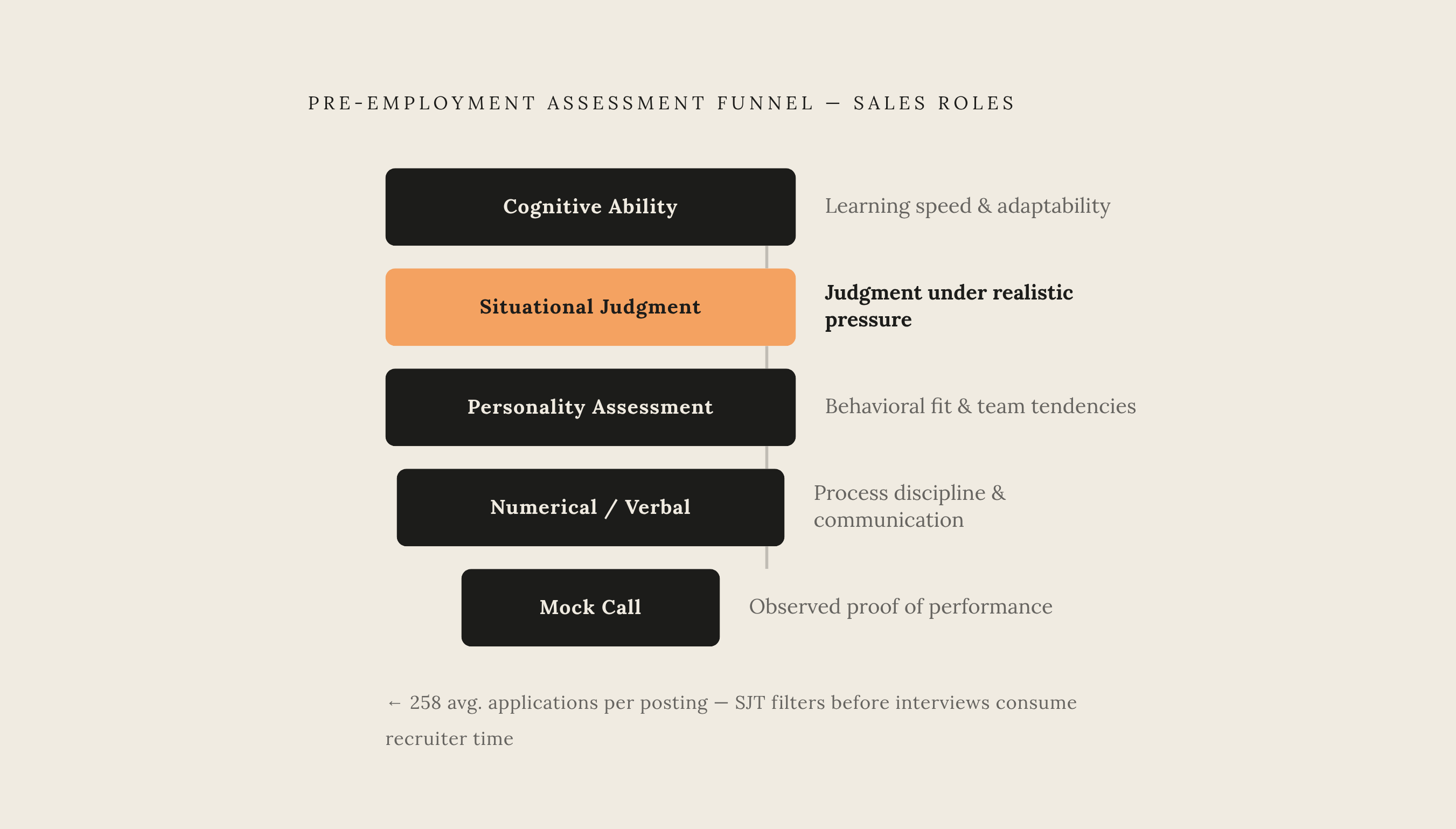
SJTs earn their keep early. They are typically deployed in the early-to-mid stage of recruitment, filtering large applicant pools by judgment before interviews start consuming recruiter time on candidates who were never going to clear the bar. That placement is not incidental. Employ's 2025 Hiring Benchmarks report found an average of roughly 258 applications per posting, up from roughly 207 the year before, and that volume pressure is exactly why structured early screening tools have expanded so quickly across sales hiring.
An SJT works best paired with adjacent instruments, not standing alone. Cognitive ability tests reveal how quickly a candidate learns and adapts. Personality assessments capture behavioral tendencies and team fit. Numerical and verbal reasoning tests speak to process discipline and communication competency. Mock call exercises or work samples add direct, observed proof of performance rather than a candidate's self-reported judgment. The strongest pre-employment process for sales roles combines an SJT or mock call exercise with a culture-fit assessment, rather than resting the entire hiring decision on a single score. In 2026, tools that finish in under 20 minutes see far higher candidate completion than 45–60 minute tests, so keep the SJT component tight or completion rates become a selection artifact. Understanding the right funnel placement sets up a natural next question (which platforms actually deliver a sales-specific SJT, and how do they differ).
That combination matters because a single score, however well validated, cannot catch every failure mode. A candidate who scores strongly on objection handling but poorly on values alignment with a collaborative sales floor is still a mis-hire, and an SJT focused on selling scenarios alone will not flag that risk. Length also affects completion rates and data quality in ways that many hiring teams overlook. Keep the SJT tight, and let the rest of the funnel carry the remaining signal. Situational Judgment Tests in Sales Hiring. What SJTs complement, per the research.
Platforms that offer sales-focused SJT capabilities
A handful of platforms build sales-specific SJT capability directly into their assessment products, and they differ meaningfully in design philosophy and depth.
Testlify runs an SJT platform used by more than 1,500 talent teams, built around DEI-first design principles, with AI-scored results that break candidates down across sub-dimensions including decision-making, conflict resolution, prioritization, and ethics. The typical assessment runs about 30 minutes, and Testlify reports completion rates above 80% on its own site, which fits the shorter-is-better completion logic that governs candidate experience in high-volume hiring.
HireVue takes a different approach, combining AI-driven video interviews with behavioral analytics layered on top of structured sales scenario assessments. It analyzes speech, tone, and behavioral signals in a candidate's recorded response, adding a predictive analytics layer that goes beyond a simple multiple-choice ranking.
Criteria Corp offers scientifically validated assessments spanning cognitive ability, personality traits, and situational judgment, positioned specifically around predicting a candidate's ability to thrive under the pressure of high-stakes sales environments.
SalesFuel's TeamTrait product blends psychometric assessment with a dedicated Sales Acumen SJT, measuring selling skills, mindset, and role fit across 24 distinct types of sales and marketing positions. It is explicitly designed to surface not just high performers but also candidates who present well without substance and personalities likely to disrupt a sales floor.
Harver focuses on predictive, assessment-driven screening workflows that include SJTs alongside gamified assessments and realistic job previews, tuned specifically for the high-volume hiring environments that make manual screening impractical.
C-Factor AI rounds out the field with an AI-guided approach to assessment design, combining gamified evaluation with interactive interview modules that let recruiters run video interviews and voice-based assessments inside the same workflow.
Each platform reflects a different bet on where the signal lives, whether in a structured written scenario, a recorded video response, or a blended psychometric profile. The right choice depends less on which platform has the most features and more on whether its scoring methodology traces back to the same discipline the research demands: excellent performers defining the responses, a separate panel ranking them, and a scoring key that gets checked against real hire performance rather than trusted on faith.
Sources
- What Is a Sales Aptitude Test? Components, Tips, ROI | Apollo
- How to Improve Sales Hiring with Situational Judgement Tests - SalesFuel
- Best Situational Judgment Tests for Hiring - Testlify
- Situational Judgment Tests as a method for measuring personality: Development and validity evidence for a test of Dependability | PLOS One
- Situational Judgment Tests
- Evidence-based appraisal of situational judgement tests (revisited)
- TeamTrait for Sales Teams | Sales Hiring | Sales Assessments | AI in Sales Testing | Situational Judgement Test for Sales
- Situational Judgment and Job Performance | Request PDF