Blind Auditions and Structured Screening in Non-Creative Roles
Separating three hiring practices reveals which interventions address different bias problems.

- Written by
- Priya Venkataraman
- Published
- October 21, 2026
- Reading time
- 9 min read
- Sources cited
- 3 sources ↓
What this covers
Blind auditions and structured screening in non-creative roles work best when treated as a layered system. Anonymizing identity, assessing job skills and keeping evaluators’ scores independent address different failures. Knowing how these failures differ helps an organization choose the change its hiring process needs, without assuming that hiding names makes the whole process fair or good at predicting performance.
Why "blind hiring" is three different interventions, not one
A hiring manager picks up a resume and can form an impression before reading a line of experience. A name, address or school may frame the account of what the candidate has done before that account receives serious attention. This is the first failure point associated with blind hiring, but it is not the only one. Even without those details, an evaluator can base a judgment on weak evidence of what a candidate can do. A panel can then compound the problem by allowing one confident judgment to become the group’s conclusion.
The label “blind hiring” covers three separable practices, namely anonymizing candidate identity, skills-first assessment and independent evaluator scoring. Identity anonymization aims to curb the assumptions people make during the first-pass review. Skills-first assessment targets pedigree bias and weak prediction by standardizing the evidence used to judge candidates. Independent scoring targets anchoring and groupthink when evaluators combine their judgments. Each practice uses its own methods at a different point in the decision, and the evidence for each differs.
A failed anonymization trial does not show that structured interviews fail, just as better predictions from interviews do not prove that resume redaction improves equity. The distinction also makes a hiring process easier to diagnose. A team that removes names but allows an unstructured panel discussion has changed the first read while leaving the evidence of performance and the way judgments are combined unchanged.
What anonymizing candidate identity actually removes — and what it leaves in
Resume anonymization removes prominent identity cues, including name, photo, age or graduation year, home address and sometimes school or employer name. It does not remove every signal of identity. Writing style, word choice and language patterns are still there and can reveal gender even after names disappear. An anonymized document is therefore redacted while retaining some identity signals. That limit matters both when people read it and when an algorithm screens it.
U.S. orchestras adopting screen-based auditions saw women’s advancement rates rise meaningfully. Yet the same format did not meaningfully increase the representation of musicians of color. The Canadian federal government’s Anonymized Recruitment Pilot Project, undertaken in April 2017, likewise produced no simple improvement. It found no net benefit or disadvantage for self-declared visible minority candidates, while significantly reducing the screening-in rate for all non-visible-minority candidates.
In the French Pôle Emploi field experiment, minority candidates were less likely to be interviewed and hired under anonymized conditions, and the interview-rate gap widened substantially. Firms in the non-anonymized comparison condition were already diversity-minded. Removing identity information removed their ability to act on that disposition.
A 2025 peer-reviewed study in Personality and Social Psychology Bulletin, published in its print issue in May 2026, found a similar problem across four pre-registered studies. Individuals most disposed toward equity were less likely to hire from underrepresented groups when materials were anonymized, yet were also more likely to choose anonymization. Visible identity had allowed them to favor underrepresented applicants actively. Redaction removed that corrective lever together with the cues that could trigger discrimination, leaving its effect dependent on the evaluation context.
Why skills-first assessment has the strongest predictive track record
Skills-first assessment addresses a question that redaction cannot answer, which is whether the evidence predicts job performance. Removing a name does not make a resume a stronger test of ability. Structured work samples and interviews change what candidates must show they can do and how that work is judged. Candidates respond to the same prompt or comparable job tasks against the same criteria. This comparability limits the room for school prestige, confident demeanor or shared vocabulary to substitute for evidence.
Schmidt and Hunter’s meta-analysis put the predictive validity of unstructured interviews at.38, compared with.51 for structured interviews. Sackett and colleagues’ 2022 re-analysis widened that contrast, ranking structured interviews first among the predictors studied at.42, while unstructured interviews fell to.19. Work sample tests and combinations of aptitude testing with structured interviewing also have a stronger predictive record than unstructured interviews and resume review. This is why structured assessment does the heaviest lifting in the layered system.
One financial planning firm put that principle to work by using structured case studies to hire for paraplanner and financial planner roles. Its assessment presented a standardized narrative of a couple’s financial situation and tax projection, tied to daily job tasks. Evaluators scored the responses against consistent criteria. Google’s re:Work Structured Interviewing Guide also lays out how to run interviews in a consistent way.
AI-polished resumes add urgency to the shift toward work samples because the presentation of an application is not the same evidence as performance on a job task. Structure also matters after an anonymous first screen ends. Charlotte Melkert, CEO of Equalture, states the limitation directly in the words “Anonymizing resumes might increase your top-of-funnel diversity, but without structured interviews, bias creeps right back in”.
Independent panel scoring: blinding the evaluators to each other, not to the candidate
The third layer reverses the usual meaning of blind evaluation. The panel can know who the candidate is, while its members cannot see one another’s judgments until they have submitted their own. This intervention operates after evidence has been gathered, at the point where separate assessments become a shared decision. It protects that evidence from the social dynamics of the debrief.
The failure mechanism is sequential contamination. Once an interviewer delivers a confident verdict, especially a senior interviewer, other evaluators can shift toward it. Their scores then cease to represent fully independent readings of the evidence. Agreement may look reassuring even though the panel has compressed several judgments into variations on the first one. A structured scorecard alone does not prevent this if reviewers can see or hear other verdicts before completing it.
The procedural fix is to require every evaluator to submit a score before seeing anyone else’s. Calibration takes place after scores are locked. Highhouse and Brooks describe the underlying framework as decomposing judgments, agreeing on standards in advance and aggregating independent evaluations. Those steps preserve separate assessments long enough for differences to be examined. Group discussion remains part of the process, but it no longer supplies the initial judgment.
The field evidence for this layer is lighter than the evidence for structured assessment, so the two should not be presented as equally established. The mechanism of anchoring is nevertheless well established, and independent scoring directly addresses it. 100Hires implements this form of blinding by hiding evaluators’ scores from one another, without natively anonymizing candidate identity.
Where each layer fits in the sequence, and why order matters
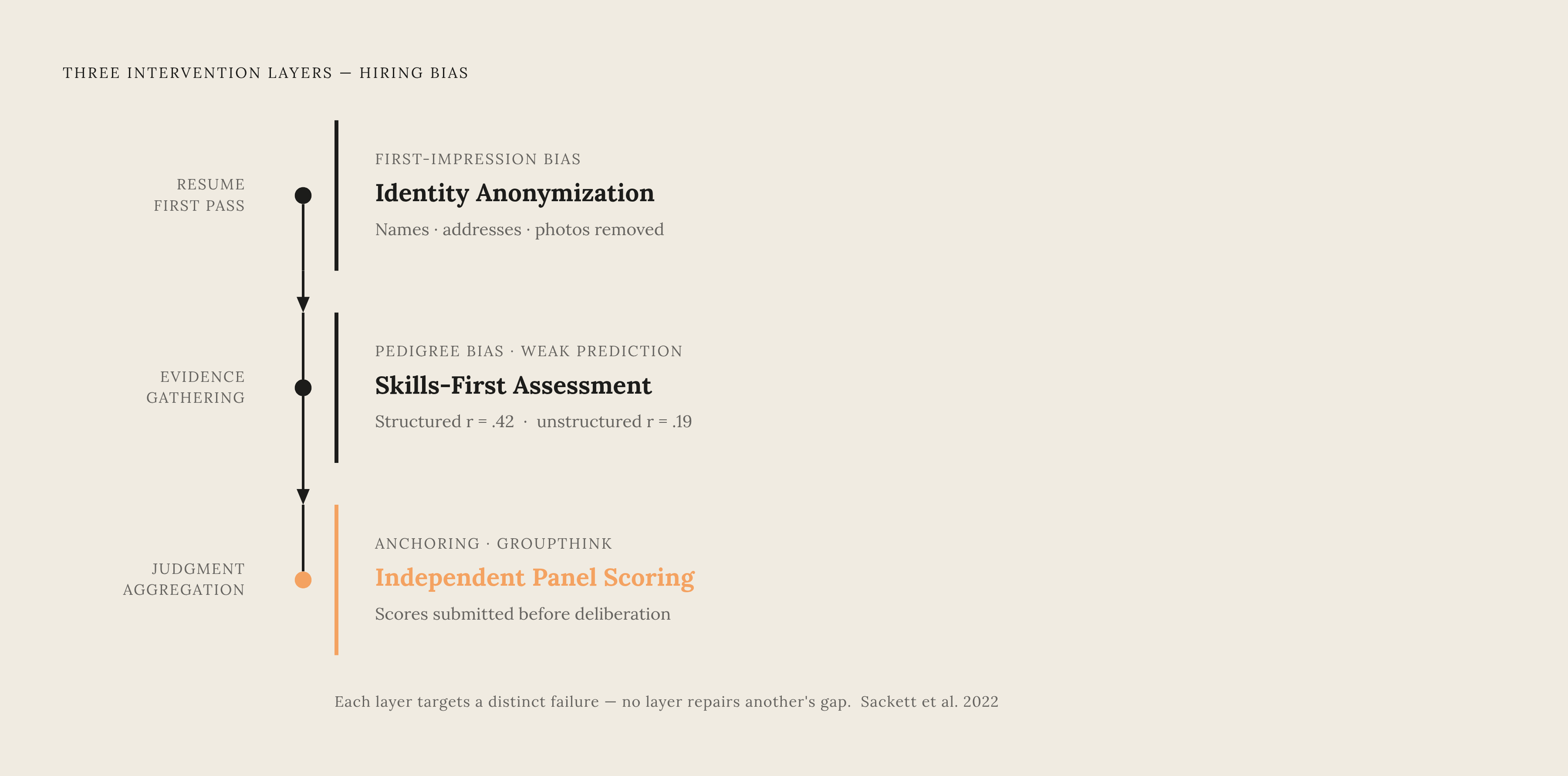
The sequence matters because each stage supplies the input for the next. The first-pass screen determines whose abilities will be assessed. Structured assessment shapes the evidence the panel gets. Independent scoring preserves that evidence as individual judgments become a group decision. A weakness early in the sequence cannot simply be repaired by greater discipline later, while a weak debrief can squander the value of careful assessment.
At the first pass, identity anonymization belongs where the context supports it, with its effects on diversity-conscious evaluation understood. Work samples and skills tests then belong before or with structured interviews, so the decision draws early on what candidates have shown they can do. At the panel stage, evaluators lock their scores before discussion. They protect different transitions in the process, from application to assessment and from assessment to selection.
This is how bias can reconstitute itself downstream. A broader shortlist created through blind screening does not guarantee a broader set of hires if later interviews reward familiarity or an undefined sense of fit. Independent scoring also cannot give a panel evidence about candidates who were ruled out before their skills were tested. The sequence can preserve or squander the benefits generated at each stage as the process moves to the next.
The rest of the process needs to follow that order too, with inclusive job descriptions, skills assessment early on and face-to-face or video interviews later. Governance controls in the applicant tracking system determine who can see personal information and when. Accommodations belong in this design from the start, including extended processing time, written response options or multimodal submission formats where needed. Standardization should make the assessed evidence comparable without making one rigid response format an unnecessary barrier.
What AI screening changes about each of the three layers
AI-assisted screening is part of this sequence and shares its risks. At the identity layer, a model can infer signals from language that resume redaction leaves intact. Historical training data can carry those patterns into automated judgments. Removing names still leaves a need to audit the model to check whether identity is influencing who gets selected.
Wilson and Caliskan’s 2024 research found that LLM-based resume screening disadvantaged Black and female-associated names when the other content was identical. A large-scale 2026 audit reported a different pattern, with every model released in 2024 or later showing either a null gap or a statistically significant pro-Black reversal. Whether that reversal represents genuine fairness or an overcorrection creating new disparities remains contested. It is a reason to audit the models used in hiring. Findings about one generation of models cannot settle the behavior of another.
At the assessment layer, AI scoring can make structured written work samples practical at volumes where manual scoring was difficult. Even with that gain in how much work can be scored, the assessment still has the same purpose: to judge job-relevant performance against consistent criteria. At the panel layer, however, AI introduces another possible anchor. An interview summary delivered before evaluators lock their scores can shape their judgments just as a senior interviewer’s early verdict can. The independence rule therefore applies to the timing of AI-generated summaries as well as human opinions.
Amaechi-Okorie and Radeljić’s research on speech diversity identifies a further design constraint. Automated speech recognition trained on standardized fluent speech can fail to recognize stuttering, neurodivergent patterns and accent-influenced speech reliably. Audio-based screening can then exclude candidates because of how they speak. For stage-three evaluation that uses voice-derived evidence, affected candidates need structured text-based or written alternatives for equity, beyond any preference they may have for a format. Locking scores cannot correct evidence that the system failed to capture accurately.
Applying the layered system in non-creative professional roles
Non-creative professional roles often offer more tractable conditions for structured assessment than the orchestral analogy suggests. Their tasks can be defined, their scoring criteria documented and their outputs assessed against a rubric. The financial planning case illustrates this fit between the assessment and the actual work. The design rule is to use a deliverable the role produces, including a memo, case analysis, projection or plan. Keep the exercise short enough not to burden candidates, publish the rubric and score the work before face-to-face contact.
Identity anonymization has also been applied at scale in professional recruitment. The UK name-blind experiment included KPMG, HSBC, Deloitte, the BBC, the NHS, Teach First, Virgin Money, learndirect, local government and the civil service, covering professional graduate and apprentice roles. Resistance came from teams using identity data for legitimate contextual purposes. That tension points toward separating systems and controlling access to information, rather than assuming that every use of identity data is improper.
The same separation is needed between who a candidate is, how the candidate presents in a room and whether the candidate can produce the required work. An undefined “culture fit” judgment collapses those distinctions and can amplify bias. Structured evidence gives later discussion a firmer basis without pretending that every hiring question can be settled anonymously. A team can start with structured interviews and locked-score panel review without putting full anonymization in place. That adopts the two layers with the strongest evidence and moves ahead of much current practice, while leaving room to diagnose whether identity-based screening is the next failure point to address.
Methodology & sources
- Unheard in the Digital Age: Rethinking AI Bias and Speech Diversity
Provided the research on automated speech recognition failing to recognize stuttering, neurodivergent patterns and accent-influenced speech, used in the AI screening section.
- Blind recruitment: a practical guide to blind hiring (2026)
Provided the example of 100Hires hiding evaluators' scores from one another as an implementation of independent panel scoring.
- Invisible Filters: Cultural Bias in Hiring Evaluations Using Large Language Models
Provided the large-scale 2026 audit finding that newer LLM models showed null or pro-Black gaps in resume screening, used in the AI screening section.