Gender Bias in Technical Interview Panels
Three biases interact during technical interviews to compound their individual effect.

- Written by
- Céleste Beaumont-Girard
- Published
- October 16, 2026
- Reading time
- 10 min read
- Sources cited
- 3 sources ↓
What this covers
- Statistical discrimination: how false group beliefs enter the room before the candidate does
- Implicit bias in the room: how evaluator behavior changes when the candidate is a woman
- Stereotype threat: how the candidate's awareness of being evaluated as a woman impairs performance in real time
- How the three mechanisms compound each other during a single interview
Most discussions of gender bias in technical hiring stop at the pipeline. They count applicants rather than examining what happens once a candidate sits down in the room. The interview itself remains the least examined site of distortion in the entire process. Around 57% of women in tech report gender-based discrimination, but the precise mechanisms that produce that number inside a single evaluation session are rarely spelled out. The interview is not merely where pre-existing bias shows up. It is a distinct environment where three documented forces activate and reinforce each other in real time.
Statistical discrimination, implicit bias, and stereotype threat are each well established in the research literature as independent phenomena. The argument that follows is that they do not operate independently during a technical interview. They interact, sequentially, each one creating the conditions that amplify the next. Understanding that interaction is the prerequisite to any structural fix, because interventions that target only one mechanism leave the other two running.
Statistical discrimination: how false group beliefs enter the room before the candidate does
Statistical discrimination names the process by which an evaluator applies assumed group-level ability distributions to an individual candidate. The interviewer carries a prior, a probability estimate of technical competence formed before a single answer is given, and gender functions as one of the signals feeding that estimate. In technical roles, the default assumption of male technical superiority operates as that prior. A woman entering the interview room must first overcome a negative probability estimate that a man in the same seat never faces.
The representation data matters here precisely because it supplies the raw material for the statistical shorthand. Lemon.io's 2025 report documents that women hold roughly one in four STEM roles and are outnumbered three to one in technical positions at major tech firms. Those numbers are not merely evidence of an earlier-stage problem. They function as the observed base rates from which interviewers, consciously or not, derive their priors. A candidate from a group that appears less frequently in the technical population is assigned a lower starting estimate of ability, and the interviewer's behavior then calibrates around that estimate.
The practical consequence is deceptively simple. The bar a woman must clear to be judged as good is effectively higher, because the evaluator's prior assigns a lower baseline. A performance that reads as adequate competence in a man reads as insufficient evidence against the default assumption in a woman. This is not a matter of animus. It is a matter of statistical reasoning applied uncritically to a domain where the group-level data does not contain the information the evaluator needs, namely whether this individual candidate can do this job. And the mechanism has a measurable footprint: 48% of women in tech face bias specifically over their technical abilities, not over their presence or their fit. The bias lands where the prior operates.
Implicit bias in the room: how evaluator behavior changes when the candidate is a woman
Statistical discrimination provides the prior; implicit bias turns it into observable behavior. The two mechanisms differ in kind, not just in degree. One is a cognitive shorthand. The other is a pattern of differential conduct that shapes the candidate's actual experience of the evaluation. Research on live coding platforms found interviewers significantly more likely to adopt a condescending and harsher tone with women candidates. The behavioral shift is measurable, and it is not a response to anything the candidate has done.
The strongest diagnostic finding from that research is the asymmetry in scoring. Women received ratings 12% of a standard deviation lower than men for code quality and problem-solving. If the gap reflected genuine performance differences, one would expect communication scores to suffer as well. They did not. The absence of a communication score gap is the tell: a candidate performing worse overall would show degradation across all dimensions. A gap confined to technical dimensions points to evaluator-driven distortion, not candidate deficiency. The interviewer's perception of technical competence shifts even when the candidate's demonstrated communication remains indistinguishable.
That perception is itself shaped by criteria that remain unexamined. Islam, French, and Ali (2026) show through interviews with female IT professionals that evaluation criteria in technical environments systematically undervalue collaboration and mentorship, work more often attributed to women, while prioritizing traits coded as masculine. This dynamic begins at the interview stage, when interviewers assess culture fit without articulating what the term means. A candidate who leads with collaborative language scores lower on technical confidence. A candidate who asserts individual ownership scores higher. The criteria are doing quiet work that the interviewer never has to name.
Implicit bias also governs what evaluators notice and remember. Behaviors identical in male and female candidates are encoded differently. A woman's directness gets read as aggression. A man's identical directness gets read as confidence. The encoding corruption persists even when rubrics exist, because the evaluator must first transform observed behavior into a category on the scoring sheet. Bias operates at the point of transformation.
Stereotype threat: how the candidate's awareness of being evaluated as a woman impairs performance in real time
The third mechanism belongs to the candidate rather than the evaluator, though the evaluator's behavior is what activates it. Stereotype threat is the cognitive burden of performing a task while aware that a negative group stereotype may be confirmed by one's performance. For women in technical interviews, the stereotype is familiar: that women are less technically able. That awareness consumes working memory. The candidate is solving a problem while simultaneously managing the awareness that her failure will be attributed to her gender, not to the difficulty of the problem or the stress of the setting.
The clearest experimental evidence comes from a randomized controlled trial on whiteboard technical interviews conducted with 48 participants. In the observed condition, no women solved the problem correctly. In the unobserved condition, all women solved it correctly. The problem was identical. The candidates were the same. The only variable was whether an evaluator was watching. Men also showed lower performance in the public condition overall, which is the point that makes the finding structurally damning: the format degrades everyone, but it degrades women categorically.
The mechanism is not general anxiety. It is a specific threat-triggered impairment of working memory, the cognitive resource that technical problem-solving depends on most directly. The public, evaluative, observed setting is precisely what technical interviews are designed to be. The format, in other words, is an optimal environment for triggering stereotype threat in women candidates. And the mechanism is self-reinforcing within a single session: impaired performance confirms internal doubt, which increases threat, which further impairs performance. The spiral tightens while the clock runs.
How the three mechanisms compound each other during a single interview
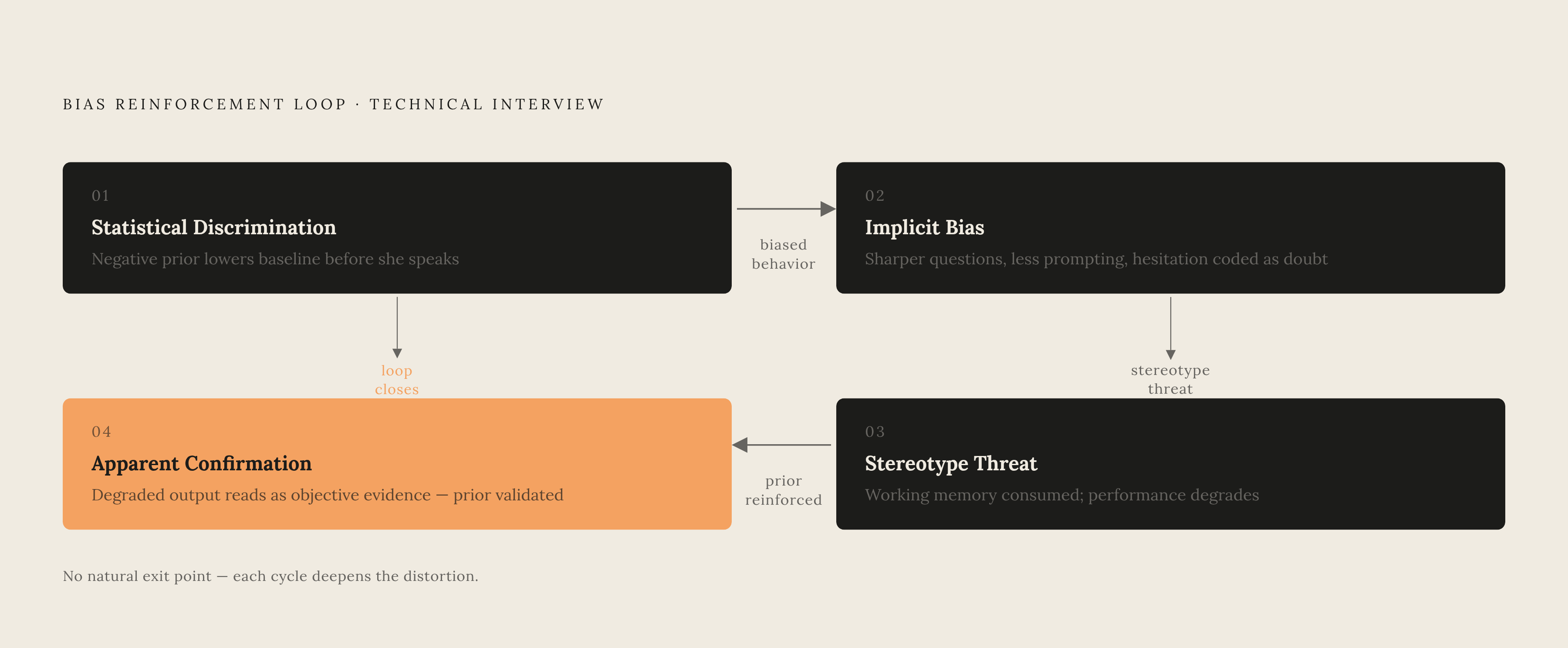
The compounding effect is what makes gender bias in technical interviews qualitatively different from isolated prejudice. Statistical discrimination lowers the evaluator's prior. Implicit bias changes how the evaluator behaves. The changed behavior activates stereotype threat in the candidate. The degraded performance then appears to confirm the evaluator's original prior. Each mechanism feeds the next in a closed loop, and the loop has no natural exit.
A concrete walkthrough makes the sequence visible. A woman enters the interview already facing a negative prior about her technical competence. The interviewer, operating on that prior, asks sharper questions, offers less prompting, and codes her hesitations as uncertainty. The candidate picks up on the differential treatment, and the activation of stereotype threat consumes working memory she needs for the problem itself. Her performance degrades. The interviewer observes the degraded performance and scores it lower, feeling justified: the candidate did seem uncertain, did make errors. The evaluator's lower score feels warranted by direct observation, without any awareness that the prior and the behavior contributing to producing those observations were themselves part of the mechanism. The loop has closed.
The interviewing.io experiment is instructive on this point. Voice-masking to hide perceived gender had no effect on performance gaps on the platform, where men had a high average technical score. The finding suggests the gap was not solely about candidate behavior under bias. Evaluator behavior itself remained a variable even when auditory gender cues were reduced. The bias was in the interaction, not in one participant or the other.
The compounding is also intersectional. The FAIRE benchmark (Wen et al., 2025) demonstrates that bias in AI-driven resume evaluation is amplified when gender and racial identity interact, a pattern that mirrors dynamics documented in human panels. Multiple identity axes accumulate bias rather than being treated independently, so the distortion of the prior scales with the number of marginalized identities a candidate carries. The loop compounds more aggressively for candidates who face more than one source of negative group assumption.
Why the standard whiteboard and live-coding format amplifies all three mechanisms
The whiteboard and live-coding interview is structurally optimal for triggering stereotype threat and maximizing the influence of evaluator priors. It is public, real-time, observed, and subjectively scored. Those are exactly the conditions the research identifies as most problematic, and they are the default format across the industry. The format is doing structural work that good intentions cannot undo.
The observed/unobserved performance gap from the whiteboard study makes the point precisely. The same problem, the same candidates, dramatically different results depending only on whether they were watched. The variable was not the content. It was the observation. Real-time coding under observation also shifts what is being measured. The format tests performance under social pressure as much as technical ability, and that pressure is not equally distributed across groups. A woman solving a problem while managing stereotype threat is taking a different test than a man solving it without that burden.
Unstructured scoring compounds the problem. When evaluators have discretion over what counts as a good answer, implicit bias has maximum room to operate. The same hesitation is scored as thoughtfulness in one candidate and uncertainty in another. The evaluator's prior determines which interpretation applies, and the prior is not neutral. Consortia's 2024 recruitment guidance implicitly acknowledges this: it identifies structured interviews using standardised questions and grading against a predetermined list as particularly effective in UX and product roles, recommending the format precisely because the default unstructured version lacks protections. The guidance names the problem by naming the fix: objective criteria, fixed in advance, leaving the evaluator less room to let the prior govern the score.
What the contested evidence on diverse panels actually shows
The intuitive remedy for panel bias is to diversify the panel, and the intuition is not wrong so much as incomplete. The evidence on whether adding women to recruiting committees helps female applicants is contested, and the strongest counterevidence is instructive. Bagues and Esteve-Volart found that the presence of women on recruiting committees can hurt female applicants. The mechanism is not fully understood. It may involve in-group competitive dynamics or overcorrection. But the finding matters because it refutes the comfortable assumption that representation on the panel is itself the fix.
A diverse panel running an unstructured interview may simply introduce multiple sources of similarity bias. Each evaluator now favors candidates who resemble them, and the biases do not cancel. They accumulate. The scene shifts from one evaluator's prior to a panel's compounded priors, and the unstructured format gives each of those priors room to shape scoring. Diversity alone, without structure, multiplies rather than constrains the subjectivity.
The evidence is clearest when panel diversity is paired with structured scoring. Diverse panels become a genuine check on individual rating patterns only when each evaluator is working against a standardized rubric, so idiosyncratic responses cannot dominate. Panel composition is a lever but not the decisive one. Structure in the process is the necessary condition. Diversity of the panel is a useful amplifier of structure, not a substitute for it. Google's experience tracks this: it reported an 11% increase in applications from women after running job postings through a bias-removal tool, while its structured interviewing initiative using standardized rubrics and trained panels was linked to improved predictive validity and candidate satisfaction. The gains came from the structure, not from who sat on the panel.
Structural changes that interrupt the compounding loop at the interview stage
The interventions that work target the mechanisms identified above. They remove the conditions that allow statistical discrimination, implicit bias, and stereotype threat to compound. They do not try to eliminate bias from individuals through awareness training alone. One-off bias training cannot withstand an interview format that reactivates the mechanisms in every session. Structural changes persist even when individual good intentions waver.
Structured interviews with standardized questions and predetermined scoring rubrics directly constrain the space in which implicit bias operates. When evaluative criteria are fixed in advance, the evaluator has less discretion to let the prior govern the score. Consortia's 2024 guidance recommends grading applicants against a predetermined list with standardized questions as one of several recommendations for fair assessment, noting particular effectiveness in UX and product roles. The recommendation is generalizable: fixed criteria anchor each evaluator's judgment, so the scoring reflects the rubric rather than the evaluator's mental model of who is competent.
Reducing the observational pressure of the format targets stereotype threat at its root. Take-home assessments, asynchronous code review, or private problem-solving before panel discussion all remove the public, real-time social context that activates threat. The candidate performs the technical work outside the observed setting. The panel evaluates the work rather than the performance of it under scrutiny. The fix follows directly from the whiteboard study's finding: if observation produces the degradation, removing the observation removes the degradation.
Diverse panels paired with structured scoring create the conditions where panel composition becomes genuinely useful. Each evaluator's score is independently anchored to criteria, so the panel serves as a cross-check on outliers rather than a source of multiplied subjectivity. Diversity becomes an amplifier of the structure rather than a separate intervention. The loop cannot run when the prior is constrained, the behavior is rubric-anchored, and the format no longer activates the threat.
Methodology & sources
- GenderBench: Evaluation Suite for Gender Biases in LLMs
Provided the statistics on women reporting gender-based discrimination (57%) and bias specifically over technical abilities (48%), as well as the 12% standard deviation gap in technical scoring.
- FAIRE: Assessing Racial and Gender Bias in AI-Driven Resume Evaluations
Provided evidence on AI-driven bias amplification when gender and racial identity intersect, and the 11% increase in applications from women after bias-removal tools, cited as the FAIRE benchmark.
- Full article: Subjectivity in performance review systems: unveiling the mechanisms of gender bias and leadership disparity in the information technology industry
Provided evidence from interviews with female IT professionals showing that evaluation criteria systematically undervalue collaboration and mentorship while prioritizing traits coded as masculine.