Audit Methods for Hiring Process Equity
Hiring bias regenerates at every stage, requiring systematic audits to measure and fix it.
- Written by
- Priya Venkataraman
- Published
- October 14, 2026
- Reading time
- 11 min read
- Sources cited
- 2 sources ↓
What this covers
Hiring bias is a structural problem that enters at every stage of the recruitment funnel independently, not a single flaw that one fix can close. The data on discrimination complaints shows the problem is not resolving on its own: the EEOC's FY 2024 report logged 88,531 discrimination charges, up year over year, with retaliation, race, sex, and disability claims leading the docket. Close to all Fortune 500 companies, about 98%, now automate applicant screening. Whatever prejudice is baked into historical hiring data gets applied to every resume that passes through the system, at machine speed, without the slowdowns that once limited how much damage a single biased reviewer could do.
Gaps opened early do not stay where they started. (2025) found that when an early callback gap hits inexperienced Black applicants, it cuts their chances to build the work history later rounds screen for, so a second, independent hiring gap opens further down the pipeline. That is systemic discrimination playing out over time, not just across funnel stages: a disadvantage at the resume stage becomes a disadvantage at the experience stage years later, for reasons that look, on paper, entirely legitimate.
A related effect works from the applicant side. In a 2025 experiment published in Behavioral Science & Policy, women became much less likely to apply for a role once they learned an algorithm used in hiring was biased against them, but men became more likely to apply when they learned bias favored them. Bias at one stage shapes the population that enters the next stage, so the next model inherits a pool that the last one's mistakes have already filtered. No single intervention, placed at one point in the funnel, can undo a dynamic that regenerates itself at every stage after it.
Scoping a structured hiring equity audit
A hiring equity audit is a systematic, data-driven review of every touchpoint in the recruitment funnel, built as a repeatable process with a defined scope, a documented method, and clear ownership, rather than a response triggered by a single complaint. Without that baseline, there is no way to know whether a later change actually worked.
Scoping the audit is a practical decision, not a formality. The right scope follows the risk: a company expanding into a state with new AI hiring or pay transparency rules, going through a merger that requires reconciling two sets of hiring policies, seeing unusual turnover in a particular group, or facing a prior EEOC or DOL inquiry all have reason to run a targeted audit outside the normal annual schedule.
Who runs the audit affects how much weight it carries. Either way, the independence and expertise behind the audit becomes part of what regulators look at, so documenting who conducted it and how is itself a compliance step. The process has to repeat on a schedule and leave a paper trail, because what regulators and courts look for is evidence of a systemic process, not proof that the organization reacted well to one bad headline.
Auditing job descriptions for language that narrows the candidate pool before sourcing begins
The first point in the funnel where bias can be measured and corrected comes before a single application arrives: the job description itself. Word choice in a posting predicts who applies, which makes the description an early and cheap place to intervene. A 2025 study published in PNAS by He and Kang found that masculine-coded language in job ads lowers women's sense of belonging and produces measurably fewer female applicants, and that replacing that language with gender-neutral wording raises application rates. A field intervention that swapped masculine terms for neutral synonyms produced a measurable increase in female applicants, a change that is small on any single posting but adds up across every job an organization publishes in a year.
Degree requirements deserve the same scrutiny. A 2026 analysis of thousands of active job postings found that most listings requiring a formal degree offered no equivalent-experience alternative, so if you built your skills outside a traditional degree path, you got shut out. Adding an "or equivalent experience" clause costs almost nothing to implement and opens the role to a wider set of applicants immediately.
Salary disclosure belongs on the same checklist. You have to check compliance jurisdiction by jurisdiction when you audit job postings, including any benefits disclosure rules that apply alongside the salary range, because a posting compliant in one state can violate the law the moment it runs in another.
Measuring funnel drop-off by demographic group to locate where screening bias operates
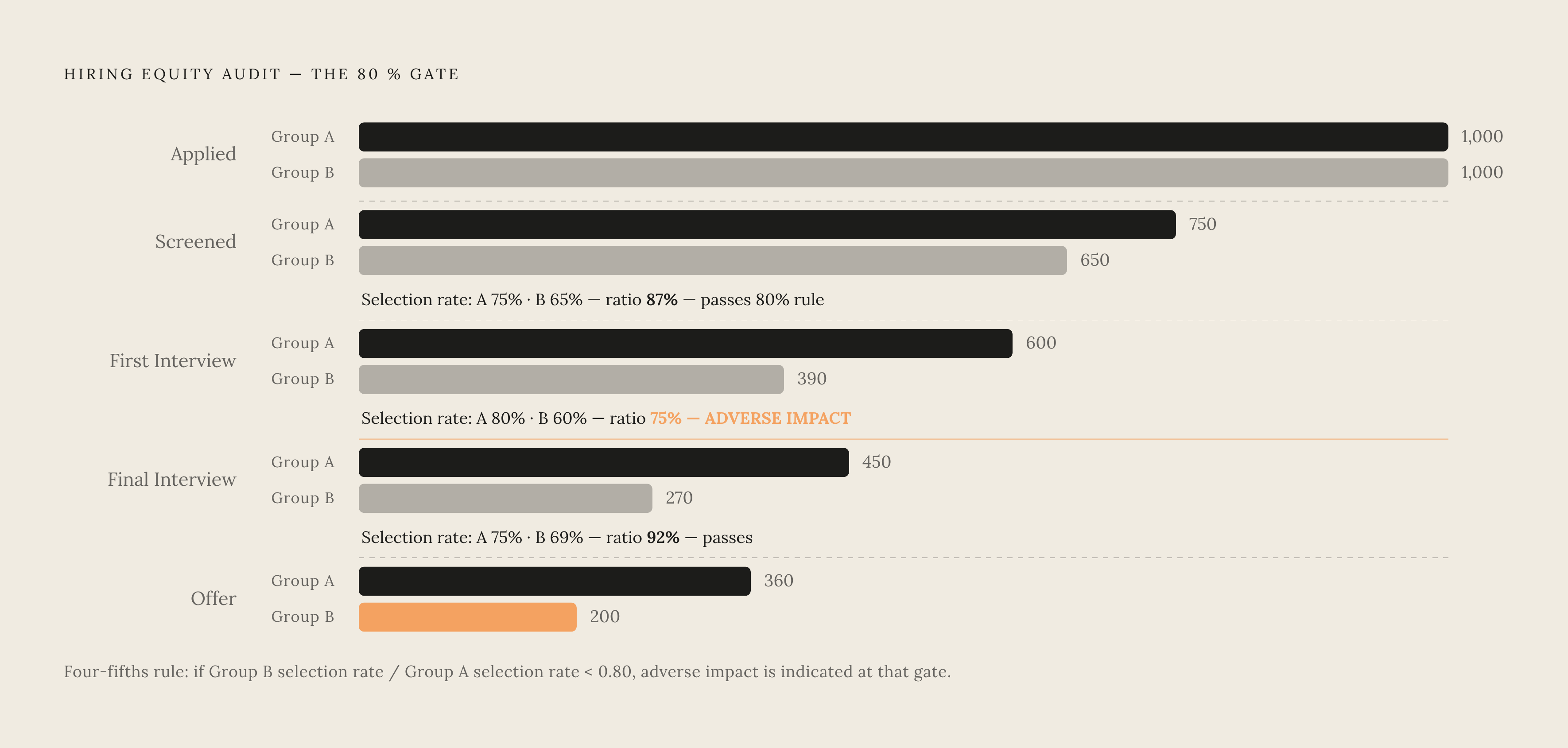
Once the language going into the funnel has been reviewed, the next step is measuring what happens to candidates once they are inside it. Tracking conversion rates by protected group at each stage of the funnel is the measurement that turns the rest of the audit from guesswork into evidence. The method itself is straightforward: pull demographic-coded conversion data at five gates, applied, screened, first interview, final interview, and offer, and look for a stage where one group drops off at roughly twice the rate of another. That gap is where the corrective work needs to start.
None of this is possible without the underlying data. Anonymized, voluntary self-identification at the application stage is permitted in every U.S. state, and federal contractors with 50 or more employees and $50,000 or more in contracts are required to offer it, while keeping it voluntary for the applicant.
Once the data exists, the audit applies the four-fifths rule: if a tool or process selects candidates from a protected group at a rate below 80% of the rate for the most-selected group, that is evidence of adverse impact. This threshold is the operational test applied to each stage's conversion numbers, turning "something looks off" into a defined, repeatable standard. The funnel audit's real value, beyond flagging a current problem, is that it sets the baseline every later audit gets compared against: without it, there is no way to tell whether a later fix changed anything.
Auditing AI-powered resume screening tools for encoded bias and adverse impact
Automated resume screening is where bias scales fastest and where it is hardest to see, because the bias lives in training data and configuration choices. The documented Amazon case and a separate case involving a multinational financial services firm both show tools that hit their own internal performance metrics, but women were still disadvantaged in the first case, and Black candidates in the second. The tool met its own performance bar while producing a disparate outcome, which is exactly the kind of failure a general process review will miss.
An AI bias audit measures selection rates across demographic groups, identifies statistical disparities, investigates what is causing them, and checks those disparities against genuine job-relevance grounds. It evaluates a specific tool configured in a specific way, not artificial intelligence as a general category.
A thorough audit of a screening tool includes several components. If you pair AI filtering for skill-relevant keywords with a human check on the output, you keep the speed of automation but still get the correction a human reviewer provides; if you automate the decision fully with no human review, that correction disappears.
The research on these tools points in different directions depending on the group studied. Separately, researchers at Stanford found that AI resume tools rated older male candidates higher than older female candidates and younger candidates. You cannot rely on another company's audit of a nominally similar tool; you have to test your own configuration directly.
Standardizing interview scoring to make evaluation data auditable
Interviews reintroduce human judgment after automated screening narrows the pool, and unstructured interviews produce evaluation data that cannot be audited at all, because the questions asked and the standards applied shift from one interviewer and one candidate to the next. Standardizing the interview is a precondition for detecting bias at this stage, not simply a nicer way to run the process.
"Culture fit" deserves particular scrutiny as an evaluation criterion. When a hiring manager says a candidate isn't a culture fit, the judgment usually traces back to the candidate not resembling the interviewer in some unstated way, which is affinity bias wearing a neutral label. For a hiring process to hold up under audit, every criterion scored in an interview has to map to a defined, measurable competency.
At this stage, the audit mechanism compares the scores a single interviewer gives to candidates from different demographic groups when they respond to the same question set. If a manager drifts off-script to ask about hobbies or family, that introduces noise into the record, and reviewing interview notes and question logs for these deviations surfaces exactly where a rubric was not followed, which is itself a finding the audit should record.
Work-sample tests offer an auditable alternative to behavioral questions. Asynchronous formats carry a related benefit: live interviews tend to favor extroverted candidates and native speakers of the interview's language, while asynchronous video or text-based assessments let candidates respond without the pressure of real-time performance, a difference that matters in particular for neurodivergent candidates.
Training interviewers on the rubric matters, but training alone will not fix the problem. Structural controls on the interview process have to accompany any training program, because what an audit examines is documented criteria and scored records, not what interviewers say they intended to do.
Using correspondence studies and field experiments to audit for bias that internal data cannot reveal
Internal funnel data can only measure what reaches the organization's own systems, and some forms of bias never leave a trace there. Correspondence studies fill that gap: fictitious applications with randomly assigned demographic markers get sent to real job postings, and the resulting callback rates reveal discrimination at the earliest stage, before a candidate ever becomes a data point inside the company. Because these studies measure the population that was filtered out before entering any internal record, they capture something a review of already-hired workers structurally cannot.
A 2025 meta-analysis of U.S. audit studies found that the gender makeup of an occupation predicts the direction of gender bias in hiring for that occupation: in female-dominated jobs, White female applicants get more callbacks than male applicants, but Black female applicants see no such advantage.
Organizations can apply the same logic internally if they submit matched synthetic profiles, varied only by demographic marker, through their own screening tools and compare callback or advancement rates. A synthetic internal version, built on the organization's own applicant tracking system, is more practical for most organizations and has the advantage of testing the actual tool in actual use.
Running regression-based pay equity audits on compensation outcomes at the end of the funnel
By the time a candidate reaches an offer, any bias that slipped through earlier stages can appear as a pay gap, and a simple comparison of average salaries by group cannot tell whether that gap reflects discrimination or legitimate differences in role, tenure, or performance. A regression methodology answers that question by controlling for the factors that legitimately explain pay differences and isolating what is left over.
The regression has to satisfy two overlapping legal standards. The Equal Pay Act requires equal pay for equal work and allows four defenses: seniority, merit, production, or a factor other than sex. Any factor used to justify a pay difference needs to be documented and reproducible, since prior pay, vague references to "market rate," or unstructured manager discretion cannot hold up as a defense if they cannot be explained and repeated on paper.
Several states widen the comparison further. Conducting these analyses under attorney-client privilege keeps the findings confidential; an organization that skips that protection may find itself required to produce the results of its own audit in a future lawsuit.
The regulatory audit obligations that now mandate these methods in specific contexts
Enforceable since July 5, 2023, it requires employers using automated employment decision tools to screen candidates for New York City positions to commission an annual bias audit from an independent auditor, publish the results, and notify candidates at least 10 business days before the tool is used on them. Employment counsel at DLA Piper warned in a January 2026 publication that employers should expect a more stringent enforcement phase, with more frequent investigations and the risk of daily penalties. This enforcement gap belongs to this specific moment, so you should not plan your compliance posture around it.
The EU AI Act takes a structurally different approach. Unlike NYC's law, the EU AI Act does not require an independent third-party audit for employment AI systems. The Act's logging requirement exists because a system that passes a bias test today can develop bias later as its training data shifts, a regulatory acknowledgment that a single point-in-time audit cannot certify an adaptive system indefinitely.
California finalized its own regulations in June 2025, effective October 1, 2025, clarifying how its existing anti-discrimination laws apply to AI tools used in hiring.
Continuous monitoring after a one-time audit
An audit captures a single moment, but the system it examines keeps changing, and that is the strongest objection to everything described above. AI hiring tools are not static. A tool that clears a bias audit today can develop disparate impact months later as its training data evolves, so the audit itself has to become a continuous process.
Research presented at AAAI 2026 and the EU AI Act's logging requirement both reflect this same concern at the regulatory level: logs of system functioning exist precisely because a tool that is fair at the moment of audit may not stay fair, and continuous monitoring is the structural answer to a problem that a single annual check cannot solve.
A continuous program translates that principle into a few concrete habits. And every audit cycle, finding, corrective action, and outcome gets documented, because what regulators and courts look for is proof that an organization had a systemic process running, not proof that it reacted well once something went wrong.
None of this depends on an organization's stated intentions. What holds up under scrutiny is the structural mechanism built into the process and the data showing whether that mechanism produced equitable outcomes over time. A continuous audit program generates that evidence as a routine output of normal operations, not as a special project assembled after the fact.
Methodology & sources
- Pay equity and transparency trends in 2025: Top points for HR leaders - DLA Piper GENIE
Provided the legal framework for Equal Pay Act defenses and the DLA Piper warning about stricter NYC bias audit enforcement and daily penalties.
- AI Bias Audit in Hiring: Step-by-Step Guide to Detect and Fix Bias (2026)
Supplied the four-fifths rule threshold used as the operational adverse impact standard in the funnel audit section.