Chatbot Screening in High-Volume Sales Recruiting
Automate credential checks to focus interviews on sales ability and fit.

- Written by
- Marcus Oyelaran
- Published
- October 28, 2026
- Reading time
- 8 min read
What this covers
Chatbot screening in high-volume sales recruiting solves a qualification bottleneck. It helps teams screen large pools of applicants quickly against the same criteria, then move those who qualify into structured human evaluation. Effective deployment therefore depends on the questions, thresholds, handoffs, and safeguards around the tool as much as on the tool itself.
Why high-volume sales recruiting breaks under manual screening
One-click apply and AI-assisted applications have made submitting an application trivial, and a single sales requisition can attract hundreds of applicants. Recruiters who review applications by hand cannot reliably keep up with that many while working quickly and applying the same standards. Recruiters read the same requirements in different ways, and they make more mistakes as they tire. The bottleneck sits between application and human interview. Better sourcing tools and applicant tracking systems do not, by themselves, resolve that qualification step.
In sales, delay also has a direct revenue cost because positions remain unfilled. Strong candidates are usually employed and considering multiple offers, so an application left unreviewed can become a lost opportunity before a recruiter makes contact. Rushing through the pile weakens judgment, while reviewing it slowly risks losing candidates. Without a structured record of why applicants advance or are rejected, manual screening also leaves hiring teams with a compliance problem.
What a recruiting chatbot actually does, step by step
A recruiting chatbot replaces the manual phone screen with a structured conversation over web chat, SMS, or WhatsApp. Candidates can complete it during evenings or weekends. The chatbot first engages the applicant and answers basic questions about the role and process. It then asks knockout and qualification questions in a fixed order, scoring responses against criteria the hiring team set before deployment. Every applicant encounters the same screening framework.
Candidates who meet the threshold advance automatically, typically to interview scheduling, while others are held or rejected with a notification. Tools with scheduling integration book interviews inside the chat at times when recruiters and hiring managers are free, using their live schedules. They also send reminders and flag no-shows. Results, scores, and candidate details then flow into the ATS, giving recruiters a single system of record.
This is conversational screening, distinct from resume parsing and ranking or asynchronous video and audio interviews. Some products combine those modes, but they perform different tasks. The distinction becomes important when defining what a screening score represents. Leading tools are also moving beyond responding to applicants. Their agentic functions include re-engaging candidates who abandon conversations, surfacing warm applicants from earlier pipelines, and flagging missed interviews without waiting for a recruiter to prompt them.
Which sales-role criteria translate into chatbot questions and which do not
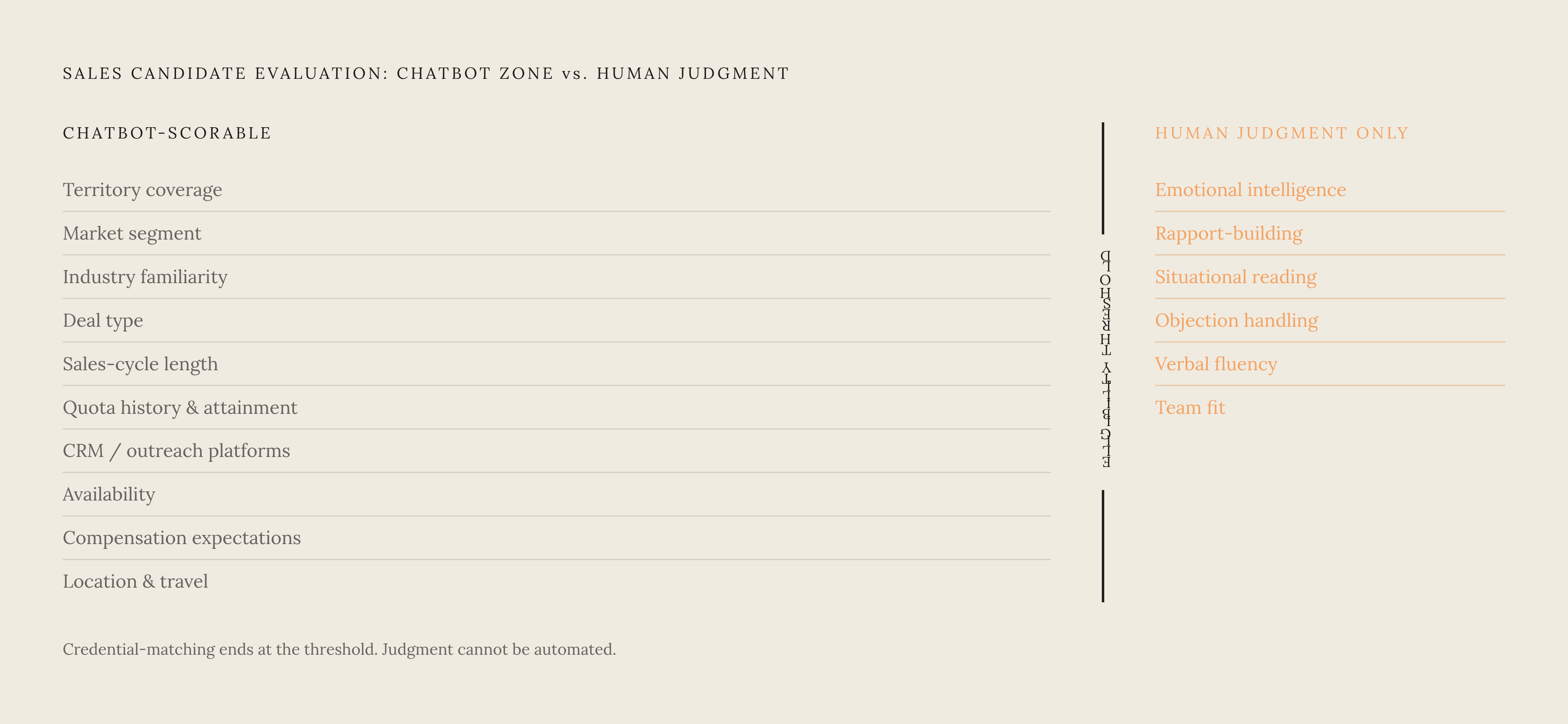
Sales eligibility translates into structured questions more readily than sales ability. Territory coverage, market segment, industry familiarity, deal type, and sales-cycle length can all establish whether an applicant has relevant experience. Quota history and attainment range offer signals for continuation, although they remain self-reported at this stage. CRM and outreach-platform familiarity add context about tools experience. Availability, compensation expectations, location, and travel requirements can expose basic misalignment before an interview.
Emotional intelligence, rapport-building, and situational reading cannot be reliably scored from text answers to fixed questions. Yet those qualities shape how a salesperson handles objections, responds to buyer pressure, and earns trust. Treating a chatbot score as evidence of them confuses two different judgments. An eligible applicant has cleared the entry requirements.
The boundary becomes sharper as the role grows more complex. High-volume transactional and inside sales roles are easier to screen through credential matching, while complex B2B enterprise sales calls for more judgment about how good the experience is. A checklist may establish that someone has sold enterprise software without resolving how well that experience fits the position. The design implication is to use factual, verifiable answers and clear minimum thresholds in the chatbot. People should handle questions that call for judgment about how an applicant adapts their behavior.
How to configure knockout questions that screen for sales-role fit without over-filtering
Hard knockouts should represent genuine deal-breakers. Work authorization, legally required licenses, and non-negotiable location or travel requirements can justify binary decisions. Minimum experience can also be a hard requirement where the role cannot be trained into, such as enterprise software sales with no ramp budget. The threshold must reflect the actual constraint.
A question asking for quota range and attainment history should generally contribute to a score. The same applies to a question about average deal size and sales-cycle length. These answers help distinguish backgrounds without treating every difference as disqualifying. A preference such as “must have sold to enterprise CISOs” can exclude viable candidates when that exact experience is not essential.
Calibration should test those distinctions against recently hired, high-performing salespeople. This should show whether the questions pick up what helps people succeed in the role or just repeat how the team has hired in the past. Semantic matching in resume and conversational hybrid tools can also reduce keyword-driven false negatives by recognizing related experience, such as “P&L ownership” and “managed a budget.” That does not rescue an unnecessarily rigid requirement. Even a well-calibrated question set produces a pool of candidates who still need human evaluation.
What happens to qualified candidates after the chatbot clears them
A cleared candidate moves into an interview with qualification data already available to the recruiter or hiring manager. The ATS record the interviewer opens should show quota history, experience flags, and what candidates say their compensation expectations are. This changes the purpose of the conversation. Instead of repeating basic data collection, the interviewer can evaluate the applicant and verify the credentials supplied during screening. A separate chatbot record forces a two-system workflow that erodes the efficiency gain.
Sales applicants evaluate the company’s people and processes while the company evaluates them, and a fast chatbot followed by slow or disorganized follow-up creates a visible discontinuity. Automated reminders cut no-shows, and agentic re-engagement can bring back candidates who drop off. The screened pool still depends on recruiter scheduling and follow-up to progress toward an offer.
The human interview must assess communication style, verbal fluency, situational judgment, and objection handling, often through a structured scenario or role-play. It must also examine team fit and verify self-reported credentials. Eligibility is now the shared starting point. Because everyone reaching this stage has cleared the credential filter, the interview becomes the primary differentiator. An unstructured conversation would reintroduce the inconsistency that automated screening was intended to remove.
The tools built for this workflow and how they differ at the point of deployment
Product fit depends on where screening sits in the hiring system and what must happen after it. Paradox’s Olivia is strongest in high-volume hourly and frontline hiring, including QSR, retail, hospitality, and logistics. Workday announced its acquisition of Paradox on August 21, 2025, and completed it in September 2025. The product became the Workday Paradox Candidate Experience Agent within its talent-acquisition suite. Its enterprise, quote-based pricing and Workday-linked roadmap make ecosystem alignment a central deployment consideration.
HireVue combines conversational screening with structured asynchronous video interviews and assessments. It fits large enterprises seeking screening and structured interviewing in one platform, and it is among the category’s highest-priced options. For sales hiring, the video layer is relevant when verbal communication forms part of the evaluation. Humanly addresses a different deployment context. Its conversational AI spans SMS, web chat, email, and voice/video AI interviewing, with a mid-market focus on removing screening administration without an enterprise-scale rollout.
HeyMilo focuses on agentic voice/video screening interviews, so it fits teams that want to use voice-based evaluation as part of screening. Sapia.ai is positioned around bias-controlled, blind chat screening for teams with a compliance priority. Joveo focuses on the handoff from paid-media candidate traffic to pre-screened, interview-booked applicants in high-volume campaigns. It combines automated screening and scoring with in-chat apply and scheduling across multiple languages. Its specific fit is converting paid job-ad traffic into qualified, scheduled candidates at scale.
These options do not occupy interchangeable positions. An end-to-end platform can unify conversational screening, the career site, CRM, and personalization, while a specialist chatbot integrates with an established ATS and sourcing stack. The architectural decision is whether the tool replaces one stage in an existing system or anchors a new full-funnel build.
The bias and compliance risks that chatbot screening introduces in sales hiring
Consistent questions do not guarantee fair outcomes across groups. AI screening can use proxy variables even when protected characteristics have been removed from the data. Graduation years can stand in for age, ZIP codes can correlate with race, and employment gaps may disadvantage candidates who took parental leave. The mechanism applies to resume parsing and conversational scoring alike. In sales hiring, bias in who first qualifies affects who reaches every later stage, including at companies that want sales teams to serve a diverse mix of customers.
Stanford Digital Economy Lab and Stanford HAI, with co-authors from Chapman University and Northeastern University, published a large-scale empirical audit in May 2026 that looked at millions of applications across scores of employers using Pymetrics. The audit found racially disparate outcomes and an “algorithmic monoculture.” Candidates rejected by one employer were significantly more likely to face rejection at others using the same underlying tool. This documents risk at scale within the audit’s scope of a single vendor. It does not establish that the same groups were excluded consistently across every employer.
Legal duties also extend beyond general guidance. California finalized regulations in June 2025, effective October 1, 2025, clarifying how existing anti-discrimination law applies to AI hiring tools. Illinois prohibits AI use in hiring that produces bias against protected classes, whether intentional or not, and requires notification when AI informs employment decisions. Colorado’s replacement law, SB 26-189, establishes disclosure, adverse-outcome explanation, and meaningful human-review obligations. It drops annual impact assessments, so requirements must be understood jurisdiction by jurisdiction.
AI-assisted screening can reduce demographic disparities relative to manual processes when models are trained on debiased data, but deployers often cannot verify that condition. Vendor positioning alone is not sufficient evidence. Before using screening more widely, hiring teams should audit its decisions for disparate impact and require vendors to document how they test for bias. They should also provide human review for borderline-threshold candidates and comply with applicable notification requirements. These controls belong in deployment planning.
What "effective deployment" actually requires beyond purchasing the tool
Effective deployment begins with criterion design grounded in performance data from current salespeople. The chosen channels must also match the candidate population and where applicants enter the process, whether through SMS, WhatsApp, or web chat. A correctly designed question has little operational value if the intended candidates do not reach or complete the conversation.
Thresholds then need periodic adjustment based on downstream hire quality. The human stage needs structured interviews that test the sales capabilities the chatbot leaves unresolved. Teams also need processes to meet compliance requirements, including bias audits, wording for notifications, and impact assessments where required. These decisions are connected. Advancing more applicants is not an improvement if those applicants are less suitable, receive inconsistent interviews, or encounter an unmanaged handoff.
A small number of roles per quarter will not generate the same return from integration and configuration as a genuinely high-volume pipeline. At scale, the sound operating model maps sales requirements to factual questions, calibrates thresholds against past hire data, and reserves structured human evaluation for communication, judgment, and objection handling. It also establishes how screening fairness will be tested.