Automating Recruiter Workflows With AI Agents
AI agents coordinate recruiting's multi-step work while keeping final decisions with people.
- Written by
- Marcus Oyelaran
- Published
- October 23, 2026
- Reading time
- 9 min read
- Sources cited
- 1 sources ↓
What this covers
Automating recruiter workflows with AI agents changes how work moves from sourcing to screening and scheduling. The gain is the ability to give a system a multi-step objective while keeping people accountable for consequential decisions. Recruiting teams benefit when they distinguish fixed rules from agent reasoning, build the foundations in the right order, and design human handoffs before deployment.
Why 2026 is the year agentic AI entered recruiting workflows
AI adoption in recruiting has outpaced workflow integration. Resume Genius’s survey of US hiring managers found that the vast majority reported company implementation in at least one part of recruitment, up from the prior year. Yet access does not establish that a team has changed how it works. The practical gap is between using AI for isolated tasks and making it part of the sequence that produces a hire.
The kind of AI available has also changed. Recruiterflow’s 2026 state-of-AI report describes the shift plainly, stating that “AI stopped just assisting and started acting”. KPMG’s Q3 2025 data showed that the share of large US enterprises with agents deployed grew from a small minority to nearly half in six months. That finding spans business functions, including recruiting. For recruiting teams, however, it makes the distinction urgent because assistive tools require people to trigger individual steps, while agents can determine and execute a sequence toward a goal.
What rule-based recruiting automation can and cannot do
Rule-based automation remains useful for predictable, linear work. A candidate reaching a stage can trigger an email, while a role remaining open beyond a set period can trigger a flag. These are genuine operational improvements. Recruiterflow’s recruitment automation playbook describes this model as following triggers written in advance, with each path mapped and unanticipated situations returning to a person.
Rules do not read context or adapt to new information unless someone has already encoded the relevant condition. A fixed sequence can send a follow-up on day three. It cannot independently notice that a candidate changed jobs, interpret the change against an open role, and draft outreach around that connection. Rules therefore belong in low-variance tasks, but they leave people coordinating the context-dependent work between those tasks.
How AI agents work differently: planning, execution, and handoff
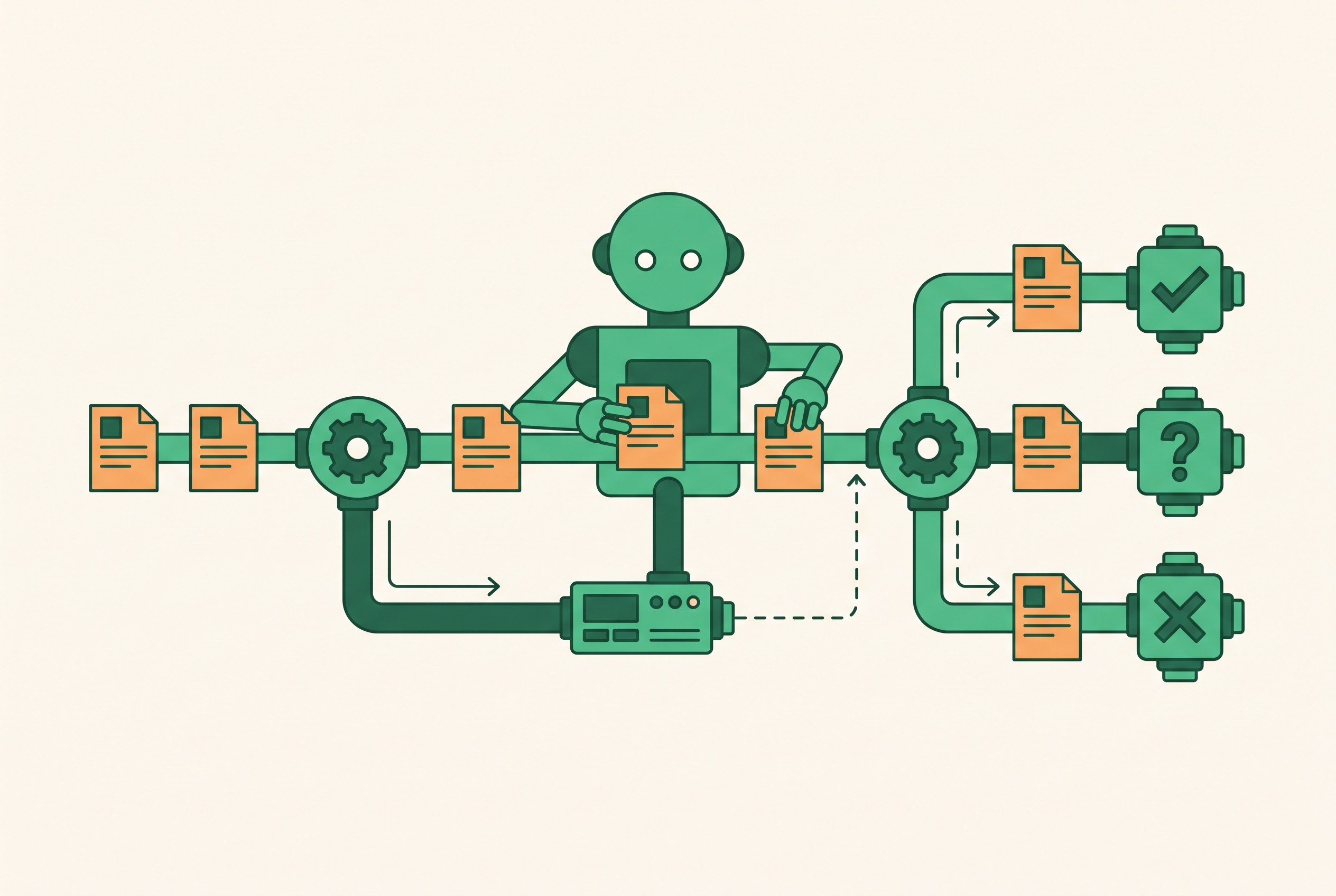
An agent fills that coordination gap by planning steps toward a goal, executing them across tools, and returning judgment calls to a person. Planning has a bounded meaning here. It means determining which steps are needed and sequencing them. The playbook describes an agent as being “handed a goal” before it plans and runs the steps, adapting as it goes.
What an agent can do depends on the permissions the recruiting team sets. Within those boundaries, an agent can coordinate sourcing, screening, and scheduling without a human initiating every action. The handoff is equally important to the operating model because decisions requiring approval must return to the recruiter at defined checkpoints. This remains an early, developing category with capabilities in specific domains. Its practical role is to manage the transactional layer.
The recruiting tasks where agents actually change the output, not just the speed
The workflow starts with records that include what was said in the latest conversation. An agent can join calls, write notes, and update the CRM automatically, reducing the gaps between a conversation and its recorded context. That improves the basis for subsequent work. Database sourcing can then move beyond a recruiter’s keyword search to role-based matching that presents candidates with reasons for each match. The playbook identifies existing CRM candidates as the source of a large majority of placements, making this particularly valuable for firms with established databases.
Current records also give monitoring a useful foundation. An agent can flag when a contact changes roles or enters a decision-making position, turning a stored relationship into a timely signal. Outreach can then use that context across email, LinkedIn, SMS, and calls, adapting to responses. Scheduling extends the same transactional support to calendar coordination, reminders, and rescheduling, where the playbook identifies measurable returns with comparatively little controversy or risk.
What real deployments look like: LinkedIn Hiring Assistant and GoodTime's Orchestra agents
Korn Ferry reported using AI to reduce administrative time, screen more candidates, and diversify its talent pool. Its reported outcomes included a substantial increase in sourcing volume and a sharp reduction in time-to-interview. LinkedIn announced Hiring Assistant 2 at Talent Connect on 29 September 2026, adding more advanced reasoning, memory, and personalization, with capabilities to identify stronger candidates and manage the entire talent pool in one place.
TCS, an early Hiring Assistant pilot user, described itself in September 2026 as “only halfway through adoption, as recruiters continue to adjust to new workflows”. The distinction is important when interpreting early results because a license does not establish routine use. A deployment must change who initiates work, who reviews it, and where recruiters re-enter the process. The evidence therefore supports a practical question beyond whether an agent is available, namely whether the team has integrated it into daily work.
The right sequencing for automating a recruiting workflow
For teams moving from access to integration, the recommended sequence begins with follow-ups and status updates. The playbook places these first because they recover lost pipeline without requiring clean data or complex configuration. They are a low-risk starting point. CRM and data hygiene come next, with automatic updates from calls and emails removing manual entry work and preparing the records on which sourcing depends.
Database sourcing follows because accurate records make matching more useful. For recruiting and search firms, those records represent years of candidate and client relationships, so using them effectively protects an existing competitive asset. Outreach comes last because personalization that fits the candidate depends on good sourcing and up-to-date context. Starting with outreach instead can scale an unreliable process. The order creates a dependency chain in which each layer improves the next.
Product capabilities can support that sequence without dictating it. Recruiterflow’s AIRA includes AIRA Notetaker for record updates, AIRA Matchmaker for database matches with reasoning, and AIRA Job Change Alerts for contact moves. Its multichannel sequences coordinate outreach across email, LinkedIn, SMS, and calls. For teams already using monday.com’s AI Work Platform, shared boards and workflows support sourcing, screening, scheduling, and reference collection. Its ready-made agents and custom agent builder let teams set up automation to fit their hiring stages, who must approve each step, and how they assess candidates.
What must stay human and why automation fails when it replaces judgment
The sequence needs a boundary around judgment and relationships. Agents can surface a shortlist, but the final hiring decision remains a human responsibility. Pew Research Center found that a large majority of the public opposes AI making that final call. A person considering a career change needs a recruiter who can engage with the decision.
The same boundary applies to assessing fit with a particular team, manager, and moment. An agent’s match reasoning prepares that assessment but does not replace it. People also need to handle offer conversations and sensitive candidate communications because these depend on trust and what is happening in each candidate’s life. Automation should prepare these interactions. Otherwise, the workflow removes the relationship-building work that distinguishes recruiting from processing applications.
AI-generated resume fraud makes human review more important as well. Generative AI can produce polished, keyword-optimized applications, weakening the reliability of volume-based screening without human assessment. More processing is not necessarily better evaluation. The recommended response is to reinvest time saved on transactional work in calibration, candidate relationships, and hiring-manager partnership. Agents change how recruiters spend their time while keeping the role in place.
Bias, data quality, and the governance gap that makes human oversight non-negotiable
Bias makes the human checkpoint a structural requirement. Screening models trained on past hiring data can repeat patterns tied to gender, educational background, or career path in later roles. A 2026 Princeton/University of Chicago study found that AI tools developed group-based biases while doing hiring tasks even when they were trained on neutral data. The study also found that the tools were more likely to form new biases than humans performing the same task.
Poor inputs introduce another source of distortion. Old job descriptions, records from non-diverse teams, and vague success criteria can degrade outputs before screening begins. Governance must address those inputs as well as model behavior, through bias audits, configured human review, and measurement of hiring outcomes. Without those controls, faster execution can amplify an existing weakness. AI can reduce noise and enforce consistency, but those benefits depend on how it is trained and deployed.
Privacy also requires teams to know what data their tools process. Hiring tools collect resumes, assessment scores, video recordings, and, in some cases, biometric signals, creating exposure under GDPR and CCPA. Candidates may not know what is collected, where it is stored, or how long it remains there. That opacity can also weaken trust in hiring decisions. Human accountability therefore includes both the conditions under which the system operates and approval of its final shortlist.
The compliance landscape recruiting teams must build around in 2026
The EU AI Act has obligations already in force. Bans on specific practices, including inferring emotions at work, have applied since February 2025, and a duty to promote AI literacy within teams also applies. Since August 2026, people must be informed when they are interacting directly with AI, such as a chatbot or voice assistant. That Article 50 requirement has a specific scope. It does not cover backend systems that filter CVs, score candidates, or assess interviews without interacting directly with people.
Standalone hiring systems come under the high-risk rules instead. A 2026 digital-omnibus regulation moved enforcement of those obligations from the earlier August 2026 deadline to December 2027. The distinction separates current duties from future requirements. It does not suspend the obligations already active. Breaking the EU AI Act can lead to fines of up to 7% of worldwide turnover, so governance affects business risk as well as compliance.
US civil rights laws also still apply to AI-assisted hiring. The EEOC removed its AI technical assistance from its website in early 2025, but Title VII, the ADA, and the ADEA remain fully applicable. Compliance responsibility rests with the employer. Recruiting teams consequently remain accountable for how agents are configured and the decisions their outputs inform.
How to build the human checkpoints that make agentic workflows both effective and accountable
Teams should specify which tasks run autonomously, including sourcing matches, scheduling, status updates, and note-taking. Shortlists, outreach drafts, and escalations should return for human review, while final decisions, offer conversations, and sensitive candidate communications remain with people. Permissions need explicit configuration. A general expectation that someone will supervise is not a substitute for deciding where work stops for approval.
Preparation should include bias audits and review of input data before launch. Records that are clean, up to date, and representative help produce useful outputs, while checks before deployment can catch problems before they affect candidates. Human review must also be informed. AIRA’s handoff model surfaces reasoning with agent output so that a recruiter can assess the recommendation. That distinction gives the checkpoint a substantive purpose.
After deployment, teams should measure quality-of-hire as well as time-to-fill to distinguish better hiring from faster processing. Informing candidates when they interact with AI should be built in universally, supporting trust while simplifying compliance across jurisdictions. These controls make the distinction between rules and reasoning operational because they define both the agent’s freedom to act and the recruiter’s responsibility to decide. Recruiters who build workflows this way gain capacity for the work that depends on them most, including relationships, calibration, and hiring-manager partnership.
Methodology & sources
- AI Hiring Tools Can Yield Racial Bias and Systemic Rejection
Cited for the EU AI Act fine of up to 7% of worldwide turnover, linking the compliance section to the business risk of governance failures.