Interview Process Length and Candidate Drop-Off Rates
Top candidates vanish from the job market faster than most hiring processes can complete.

- Written by
- Céleste Beaumont-Girard
- Published
- November 3, 2026
- Reading time
- 8 min read
What this covers
- Why the interview stage is the most expensive place to lose a candidate
- The window in which top candidates remain available is shorter than most hiring processes
- Scheduling delays are the first and most reported reason candidates exit mid-process
- Round inflation compounds scheduling delay by multiplying the number of moments a candidate can exit
The length of the interview process affects candidate drop-off in two linked ways, scheduling delays and round inflation. The interview stage concentrates losses after employers have already invested in candidates, while the strongest applicants can leave the market before a lengthy process concludes. Recruiters have the clearest leverage when they identify where those losses occur and address the specific gaps, rather than treating every withdrawal as a reason to hire faster.
Why the interview stage is the most expensive place to lose a candidate
A candidate who leaves at the interview stage takes more accumulated investment out of the funnel than one who exits at application. Sourcing, screening, and scheduling have already taken time and resources. Those are also expensive stages to repeat when an employer needs to replace a candidate who withdraws. Interview-stage retention affects how much of that earlier effort produces a hiring decision.
The interview stage is also where hiring funnels lose the most candidates. Manufacturing shows this concentration clearly, with drop-off peaking at interview. Greenhouse’s The Hire Standard, published in March 2026 and covering thousands of companies and hundreds of millions of applications, provides progression benchmarks that help describe funnel attrition. Its Stage 1 and Stage 2 labels do not define the specific stages, however, so they cannot establish precisely where interview withdrawals occur. That distinction is important when interpreting the cost of loss, because progression data describes who advances.
Earlier investment has reached the point of evaluation. When candidates withdraw there, adding more applicants does not address the point at which that investment is being lost. It brings in replacements who have to go through the same process.
The window in which top candidates remain available is shorter than most hiring processes
HiringThing’s 2026 job application data puts average time-to-hire at over a month, with additional interview rounds, assessments, and stakeholder input extending the process. Top candidates are reported to leave the market within days of becoming available. The two timelines are poorly aligned from the outset. A process can still be moving according to its internal plan when a strong applicant has already accepted another opportunity. Internal progress is not the same as continued access to the candidate.
Candidates with the most options have a shorter runway before a competitor can make an offer, so an employer’s preferred evaluation schedule does not determine how long they remain available. Thoroughness may explain why a process takes time, but it does not protect the employer from that competing timeline. Delay exposes the strongest applicants to other offers while the hiring team is still gathering input.
Average time-to-hire also describes the employer’s completed process, which can extend beyond the availability windows of candidates who entered it. That difference limits what the average can reveal. An employer may see a month-long process as normal even as it loses applicants to other employers who move faster.
Scheduling delays are the first and most reported reason candidates exit mid-process
Scheduling friction is the most frequently cited reason candidates withdraw from an active interview process. It operates before evaluation has even begun. A candidate can be willing to interview and still leave because arranging the conversation takes too long. That makes scheduling an independent source of attrition, rather than a minor administrative component of interview quality. Improving the questions asked in an interview cannot recover someone who never reaches it.
Candidate expectations provide a practical benchmark for that gap. A substantial portion expect an interview to be scheduled within days, a larger share within a week, and the remainder within a few weeks. Even the outer edge is well under a month. These expectations concern the wait to arrange an interview. Comparing them with overall time-to-hire would obscure the specific delay candidates are judging.
In the iCIMS 2025 State of Frontline Hiring Report, managers rank scheduling second among the points where they lose candidates, just behind the interview stage itself. The report covers U.S. hourly frontline workers and frontline hiring managers in healthcare, hospitality, manufacturing, and retail. That scope should remain attached to the finding. Within it, the separate ranking supports an important distinction between losing candidates while arranging an interview and losing them during the interview process.
Silence makes the scheduling gap more damaging. Candidates can interpret a lack of communication as rejection and withdraw before a conversation occurs. JobScore’s 2026 interview statistics identify candidate self-scheduling as a direct way to reduce this friction and support faster first contact. The change alters how scheduling works instead of asking recruiters to do the same work faster. Because this loss point exists separately from the interview itself, correcting it can produce gains without changing the evaluation.
Round inflation compounds scheduling delay by multiplying the number of moments a candidate can exit
Extra rounds add interview time, and each requires another scheduling event, another wait, and another opportunity for a competitor’s offer to arrive. The exposure grows with the number of transitions. A delay that looks manageable in isolation becomes more consequential when candidates encounter it repeatedly before receiving a decision.
A large share of candidates think even 2–3 rounds are too many, while more than half think 4–5 are too many. These findings challenge the assumption that candidates accept each additional meeting as evidence of diligence. Employers may see another opportunity to evaluate. Candidates may see one more thing they have to do before the employer is ready to decide.
A majority report that their interview process remains too long even after efforts to shorten it. Faster coordination can leave the underlying sequence intact. If every round remains necessary in the eyes of its stakeholders, improvements to individual steps may not remove the repeated waits that create withdrawal opportunities.
The downstream outcome is more serious than an unfinished interview. Nearly a third of North American candidates who withdrew said they had accepted another offer elsewhere. Only roughly half of candidates accepted their most recent job offer in Q4 2025, compared with a much higher share in Q4 2023. That decline tracks with longer, more complex processes and a market offering candidates more options, although it does not isolate process length as the cause. It makes distinguishing fixable delay from other sources of rejection essential.
Process length is not the only driver of withdrawal, and conflating them leads to the wrong fixes
Interviewer behavior is a separate reason candidates leave. Nearly half of candidates in reported surveys said an interviewer’s attitude or behavior would cause them to withdraw voluntarily. Scheduling improvements cannot resolve that problem. A candidate who reaches the interview promptly can still reject the experience of being interviewed.
What candidates expect to be paid can also cause them to leave, however fast the process moves. Pay transparency affects candidates earlier in the funnel, but its absence can continue to influence decisions through the interview stage. Candidates who reach interviews without clear compensation information are more likely to exit when the reality differs from their expectations. A shorter process may simply bring the disagreement into view sooner.
These limits refine the argument for faster scheduling and fewer unnecessary rounds. They do not weaken it. Both remain structurally fixable sources of attrition, but neither substitutes for a process that respects candidates’ time, provides clear compensation information, and avoids poor interviewer behavior. The intervention must fit the reason for withdrawal. Otherwise, a team can improve speed while leaving its interview-stage losses largely unexplained.
Where recruiters have the clearest leverage in scheduling velocity and round design
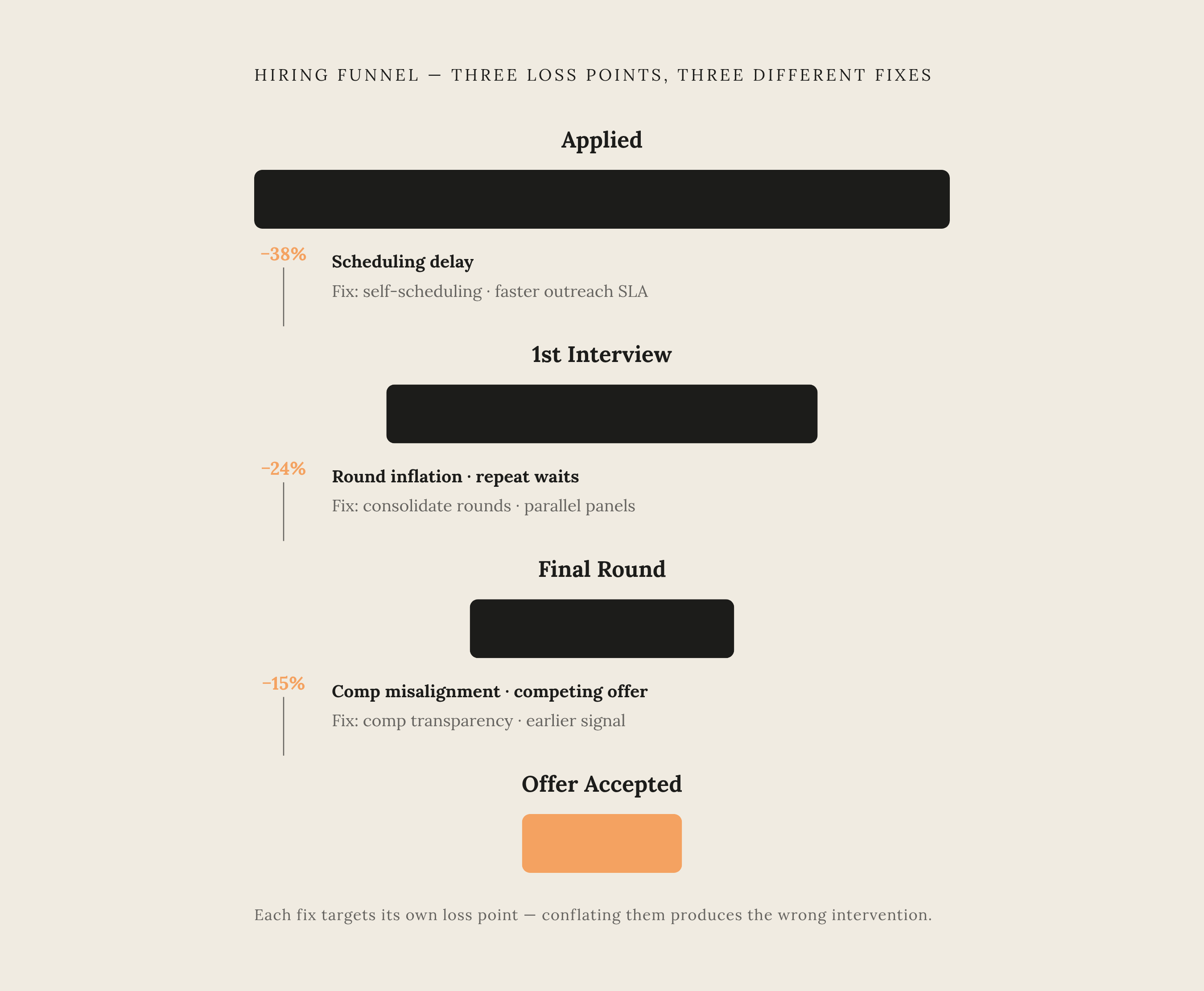
The practical response is to address scheduling gaps and round design as connected problems. Candidate self-scheduling compresses the wait without requiring recruiter intervention at each step. Faster outreach also addresses the period in which candidates are waiting for evidence that the process is moving. These changes target access to the first conversation. They are most relevant when candidates disappear before the employer has had a chance to evaluate them.
Round consolidation addresses a different form of exposure. It reduces the number of scheduling gaps and withdrawal windows while preserving the evaluation the hiring team needs. Parallel-panel design can also help when most losses happen between rounds. The objective is to avoid making candidates pass through unnecessary sequential waits to provide the required hiring signal.
Technology can support those changes, but its role needs precise description. Teams using AI-powered candidate screening have reported substantially faster time to interview in platform-reported data. Those reports show what may be possible, but they do not prove that every team using the technology will get the same result. Amazon’s official newsroom describes AI use for real-time interview transcription and matching candidates to roles based on skills and experience. Those applications illustrate support for hiring work, but do not establish a reduction in scheduling delays or candidate withdrawal.
Greenhouse’s Orchestrated Hiring Ecosystem, introduced in October 2026, brings sourcing, interviewing, scheduling, and the applicant tracking system together. It also includes access to millions of job seeker profiles on MyGreenhouse while remaining open to outside tools. The company names Anthropic, HubSpot, and the NFL among the thousands of companies running their hiring on its platform. Its stated aims include reducing manual scheduling work and sharpening hiring signal. Coordination is the relevant principle, and removing unnecessary rounds requires more than adopting a new tool.
What recruiters should measure to know whether their process is losing candidates to speed or to something else
Drop-off between application and first interview points to scheduling velocity, especially when candidates say it was hard to arrange the meeting or they waited a long time to hear back. Self-scheduling and faster outreach service-level agreements address that pattern. Losses between rounds suggest a different problem. They point toward consolidation and parallel-panel design rather than faster scheduling of an unchanged sequence.
Offer-stage losses require a separate interpretation. Low acceptance can reflect compensation misalignment, the process experience, or a competing offer. Scheduling speed is no longer an intervention for that completed journey, even if earlier delays contributed to the outcome. The offer-stage signal therefore needs context from what preceded it. A rejected offer alone cannot distinguish dissatisfaction with pay from a candidate’s decision to accept an opportunity that arrived sooner.
Progression benchmarks can help locate unusual losses, provided their definitions are understood. The Hire Standard gives progression benchmarks for Stage 1 and Stage 2, but does not say which stages those labels stand for. They provide a baseline with a clear limitation. Recruiting teams cannot assume that their own first and second interview rounds are directly comparable to those categories.
Asking candidates after they leave, rather than surveying only those hired, helps separate excessive waiting from interviewer behavior and compensation mismatch. The applicant tracking system already holds much of the information needed to examine where candidates stop progressing. Exit feedback helps explain why they stop. Fixing the funnel therefore requires a shift from judging one aggregate time-to-hire figure to reading its shape by stage, with the intervention determined by the location and cause of loss.