Assessment Center Design for High-Stakes GTM Hires
Assessment centers predict GTM leader performance two to three times better than interviews alone.

The strongest SaaS companies have stopped treating headcount as the lever for growth, a change that makes assessment center design for GTM hiring a serious discipline. ICONIQ's Building the Modern GTM Org report, cited widely in SaaS leadership coverage, finds that top performers generate much more revenue per employee than their peers do. The old model, where growth problems got solved by adding another account executive or another SDR, is giving way to something leaner and more demanding of the people already on the team.
What that leaner structure asks of a single hire has changed in kind, not just in degree. A commercial hire today needs to cover more of the customer lifecycle than the job used to require: discovery, expansion, renewal, and strategic account management, often within the same role that used to be scoped as pure prospecting. Commercial curiosity and account strategy now sit next to pipeline generation as baseline expectations; they are no longer bonus skills.
This matters because a single competency model built around a quota-carrying AE cannot describe what a full-cycle commercial operator does all day, and it describes even less of what a GTM Engineer does. The GTM Engineer role blends technical build work, like enrichment workflows and signal activation, with commercial judgment, and no legacy sales competency framework was built to capture that combination. Role fragmentation inside GTM organizations is a structural fact, and it means the tools used to evaluate candidates have to fragment along with the roles, or they will keep measuring the wrong thing.
The cost of a wrong GTM hire, beyond the severance check
When a single hire covers more ground, a wrong hire does more damage, and that damage compounds in ways a severance agreement never captures. The direct cost of a failed GTM executive hire, in base pay, bonus, and buyout, is already large on its own. The costs that follow it, a stalled pipeline, a revenue team that watches its leader get replaced and starts quietly job-hunting, months of lost market momentum, are what turn an expensive mistake into an existential one.
For a company with 18 to 24 months of runway, a single bad GTM executive hire can threaten the company's survival once compensation, lost revenue, team turnover, and the opportunity cost of time are added together. Fundraising timelines don't pause for a failed search. Competitors keep closing the deals a stalled sales org can't get to, and the runway clock keeps running regardless of whether the VP of Sales hired in January is still in the building by September.
The stakes scale with seniority, and they scale unevenly. A wrong AE hire costs a team a missed quota and a few wasted months of ramp. A wrong CRO hire can reset a company's entire commercial trajectory by well over a year, because a CRO's mistakes don't stay contained to one function: they reshape hiring plans, territory design, forecasting discipline, and the confidence of a board watching the number miss quarter after quarter. Given what that kind of miss costs, the next question is what actually works to prevent it, and the evidence here points away from the tools most companies still rely on by default.
Why traditional interviews fail to reveal performance ability
An interview, even a well-run one, tests a candidate's ability to describe performance convincingly. It does not test the candidate's ability to produce that performance under real conditions. A candidate can narrate a flawless discovery call without being able to run one, and a panel of interviewers has no reliable way to tell the difference until the candidate is already three months into the job.
Structured interviewing helps close part of that gap. Standardized questions and consistent scoring make scoring more reliable than free-form conversation does, so structured interviews still belong in a well-built evaluation process. But researchers Highhouse and Brooks show that selection noise gets reduced through three specific practices: decomposing judgments into separate components instead of one holistic impression, agreeing on evaluation standards before anyone meets a candidate, and aggregating independent evaluations rather than letting one strong voice in the room set the outcome. Interviews alone rarely meet all three conditions in practice, because most interview loops still end in a single debrief where the most senior person in the room anchors everyone else's opinion.
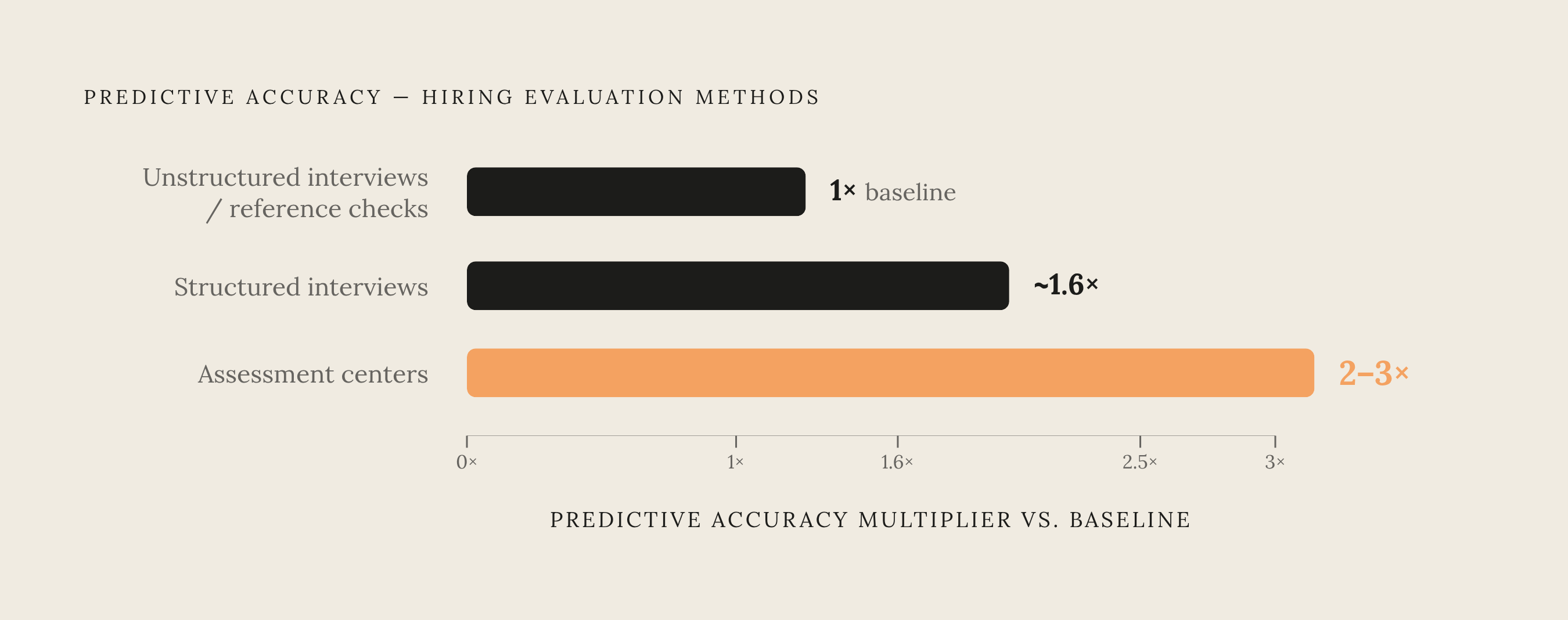
For leadership roles, the performance gap between methods is not subtle. Assessment centers predict future performance two to three times more accurately than interviews or reference checks alone. The most common objection to replacing or supplementing interviews with a full assessment process is cost and time, but that objection has to be weighed against the cost structure described above: a CRO mis-hire that resets a company's trajectory by a year costs far more than an extra day of structured evaluation at the finalist stage. Rigorous assessment is the economical choice once the downside of getting the decision wrong is on the table.
The validity evidence for assessment centers, and its limits
Assessment centers carry real predictive power, but that power depends entirely on how well the exercises are built, and the evidence supports well-constructed centers specifically, not the format in general. Treating "assessment center" as a label that guarantees rigor is the mistake that undermines the whole approach before a single candidate walks in the door.
The clearest limitation in the research literature is what I/O psychologists call the exercise effect: performance in assessment centers tends to be specific to the exercise a candidate just completed rather than to the underlying competency the exercise was supposed to measure. A candidate who performs well in a role-play exercise and a case study exercise may be showing two unrelated skills rather than one consistent trait called "strategic thinking," and when assessors assume otherwise, the center produces a false sense of precision. Dimension-level scores claim to isolate a trait like leadership or judgment across multiple exercises, but they mean less once you account for this effect.
For GTM hiring specifically, the exercise effect carries a direct warning: if assessors believe they are measuring strategic thinking across several exercises but are actually measuring performance on one narrow task repeated in different clothing, the center generates confidence that has no basis. The fix isn't abandoning the format. The fix is building exercises that are demonstrably tied to the actual work of the role, rather than pulled from a generic competency library that was written for no job in particular. Assessment centers have gone mainstream across executive search, but rigor didn't go mainstream with them. Many executive assessment products in wide commercial use have little or no published research showing that their results predict who will actually succeed once hired. That gap between popularity and evidence is exactly where design quality has to do the work, and it sets the terms for the practical question that follows: what does a GTM-specific exercise bank actually need to contain?
Designing assessment center exercises that reveal true GTM capability
Exercise design has to start with role differentiation, because the competencies that separate a strong performer from a weak one are not the same across GTM functions. An SDR assessment should test cold outreach writing and sequencing logic, because that is the actual daily work of the role. An AE assessment should focus on discovery skill, objection handling, and deal strategy, because that is where AE performance diverges most sharply. A CRO assessment should surface strategic decision-making, cross-functional leadership, and revenue architecture thinking, because a CRO's job is rarely about any single sales conversation; it is almost always about the system around it.
Work-sample exercises form the core of a GTM-specific center, because they ask candidates to do the job rather than describe it. A simulated conflict exercise, a difficult employee conversation or an argument with an unhappy customer, tests social skill, empathy, willingness to compromise, and the capacity to handle friction without making it worse. That combination is difficult to fake and nearly impossible to prepare for with a rehearsed answer, which is what makes it diagnostic.
For senior GTM leaders, case study analysis answers a different question: can this candidate reason through ambiguity the way the job will actually require? Presenting one or two case problems, a stalled pipeline, a pricing decision, a market entry scenario, and asking the candidate to work through it gives assessors a direct look at critical thinking and strategic judgment under constraints that resemble the real job. The goal isn't a textbook-correct answer. The goal is visibility into how the candidate reasons when the data is incomplete and the stakes carry real consequences, week after week, for a CRO.
Coachability deserves more weight than most hiring processes give it, and it happens to be one of the easiest signals to observe directly. After a mock sales call, a coach can offer specific guidance and ask the candidate to run the call again. If a candidate absorbs that feedback and visibly adjusts their approach on the second attempt, they are showing the adaptability that leaner, full-cycle GTM roles demand every day, since those roles change shape faster than a rigid playbook can keep up with.
The GTM Engineer role needs its own exercise bank entirely, because its competencies have no analog in a traditional sales leader assessment. Evaluating enrichment workflow design, signal activation logic, or tool integration strategy requires technical scenarios built specifically for that work. Borrowing a sales leadership case study and hoping it transfers to a GTM Engineer candidate repeats the exact mistake the exercise effect warns against: measuring something other than what the role actually requires.
Multiple assessors, standardized scorecards, and structured aggregation for reducing decision noise
Well-designed exercises only produce a defensible hiring decision if the process around them is built with equal care. Without a structured way to collect and combine what assessors observe, even the best exercises turn into raw material that gets overridden by whoever speaks loudest in the debrief room.
Standardization is what makes scores comparable from one candidate to the next, and scoring independently before discussing must come before comparing notes. Assessors who score a dimension independently, then compare notes afterward, catch more real signal and introduce less shared bias than a group that discusses a candidate's performance first and settles on a score together. Discussing first lets the most confident person in the room set the frame that everyone else's score gets fitted to, undermining the purpose of having multiple assessors.
The scorecard itself has to come from a job analysis completed before any candidate is assessed. Dimensions invented after watching a candidate perform, or quietly adjusted to justify a favored outcome, aren't dimensions in any meaningful sense: they're after-the-fact rationalizations wearing a scorecard's clothing.
For senior GTM roles, the most defensible setup pairs an assessor with direct revenue leadership experience alongside an I/O psychologist or a structured assessment specialist. The domain expert catches the role-specific nuance that a generalist would miss entirely, like recognizing whether a candidate's pipeline math actually holds up. The psychologist's methodology keeps that domain knowledge from sliding into confirmation bias, where a revenue leader gives high marks to a candidate who simply thinks the way they do.
Speed is the most common objection to building this level of process, since founders and PE-backed operators are often working against a clock that doesn't allow for a long search. A well-designed center with scorecards built in advance and a clear exercise sequence can run in a single day at the finalist stage. The fast version of this process still requires the infrastructure to exist before the search begins. Speed at the point of assessment is earned by doing the design work early, not by skipping it.
Genuine efficiency and documented risk in AI-powered assessment tools
AI-powered assessment tools can genuinely cut cost and expand how many candidates a company can evaluate at once. HireVue uses AI to score certain structured video interviews and games, but its Virtual Job Tryout simulations rely on established psychometric scoring methods, not AI. Vervoe grades work-sample tasks using what it describes as explainable AI. Both have scaled quickly because they cover more candidates at a lower per-candidate cost than specialist psychometric vendors can match.
That efficiency comes with a trade-off: individual tests inside AI-powered tools tend to run shorter and shallower than the exercises built by specialist vendors, and the published evidence that these scores predict actual job performance is thinner across the board. One investigation looked at 18 algorithmic pre-employment assessment vendors and found that only one had published validation studies showing its models actually predict success in the role.
The bias evidence is no longer theoretical. Stanford HAI published the first large-scale study of hiring algorithms in the wild in May 2026, and it tracked 3.4 million people who submitted 4 million job applications across 1,700 job postings at 150 employers in 11 industry sectors. The study found that AI hiring tools increase racial bias, and that the same candidates get systematically shut out of jobs across every employer where they apply, since the same algorithmic patterns repeat from one company's hiring pipeline to the next.
None of this means AI has no place in GTM hiring. It means the tools vary enormously in rigor, the bias evidence is now serious enough to warrant regulatory attention, and the responsible use of AI is to augment a human-anchored process rather than replace it. AI-augmented screening, automated scheduling, structured video prompts, preliminary scoring that narrows a large applicant pool, can compress the time it takes to reach a finalist slate without replacing human assessors at the point where the actual decision gets made. That's a defensible position for 2026, but it holds only when the AI component being used has published validity evidence and a documented adverse impact review specific to the role and the population of candidates being assessed. Skipping that review to save a week of search time trades a small amount of speed for a legal and ethical exposure that no efficiency gain is worth.
Connecting assessment results to onboarding, ramp, and retention
An assessment center that produces a hiring decision and nothing else has only delivered part of its value. The same competency model that identified the right candidate should carry forward into the first manager review, the ramp plan, and the coaching agenda that shapes the new hire's first quarter.
Once a candidate is hired, their discovery call simulation from the assessment becomes the natural baseline for onboarding. What the assessors observed during the role-play, where the candidate handled objections well, where their questioning got thin, where they struggled to pivot when the simulated buyer pushed back, is more specific and more useful than anything a new manager could gather from a first 30 days of shadowing calls. That observation turns into a coaching plan on day one instead of a guess made after watching a few live customer calls go sideways.
The same logic applies to the coachability signal you gather when you run the mock call retry. A candidate who struggled with one specific type of feedback during the assessment is very likely to need the same kind of coaching once they're in the seat, and a manager who knows that going in can build a ramp plan around it instead of discovering the gap the hard way during a lost deal. The assessment center, built well and connected forward into the first year of the role, pays for the rigor it took to build.
Sources
- Hiring a GTM Executive: Strategic Asset or Expensive Failure?
- The Real Cost of Getting GTM Hiring Wrong (And How to Get It Right the First Time)
- 8 Big Mistakes Companies Make When Hiring GTM Leaders (and How to Avoid Them)
- Structured Interviews: How to Run Them and Why They Work (2026) - Pin
- (PDF) Assessment centers: Reflections, developments, and empirical insights
- Assessment centers do not measure competencies: Why this is now beyond reasonable doubt
- Revisiting Meta-Analytic Estimates of Validity in Personnel Selection:
- Full article: Improving assessment center criterion validity for salesperson selection: a socioanalytic approach